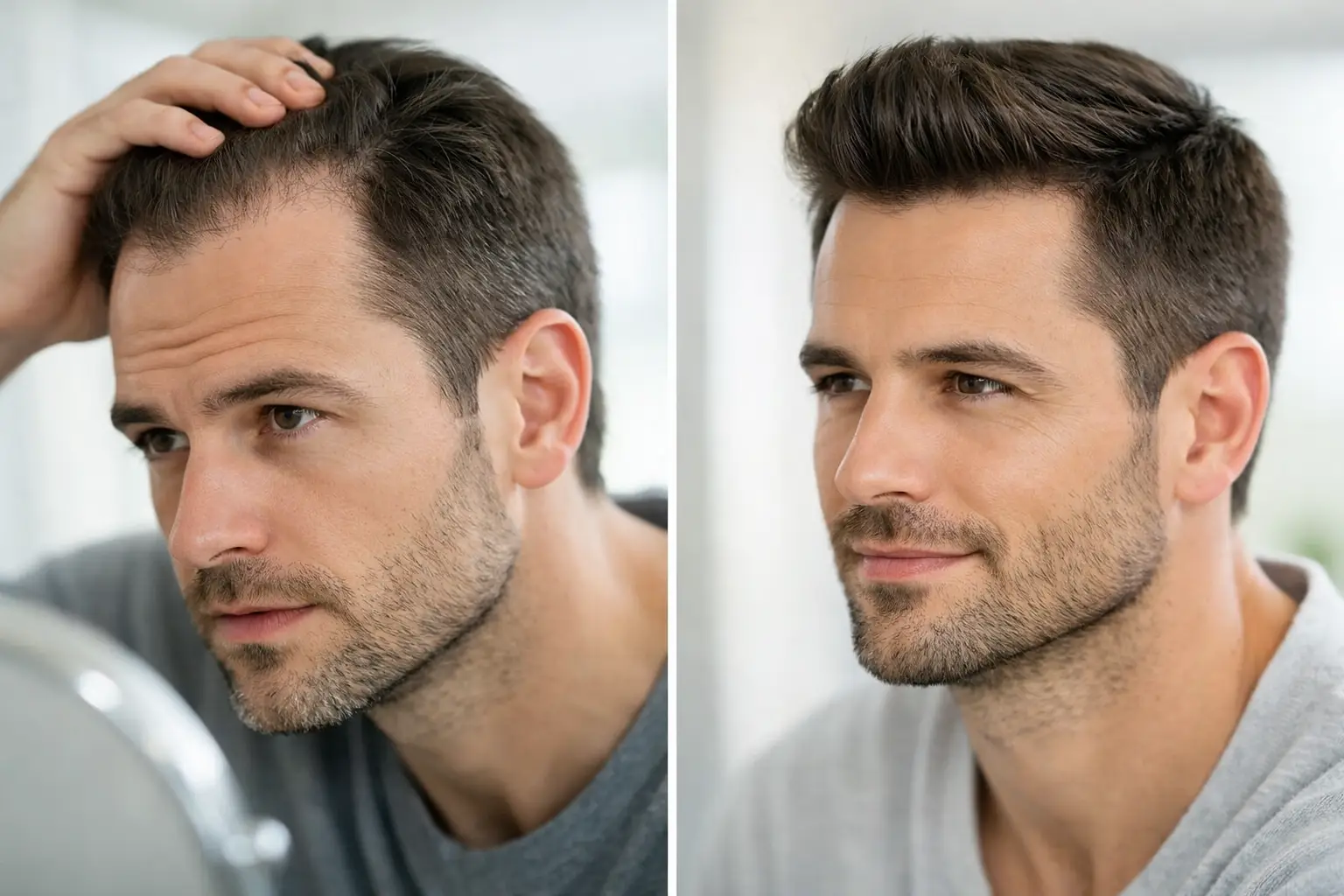
A sharp hairline can make a full head of hair look artificial, while the right one can make even a modest restoration look convincingly natural. That is why hairline design for men is not just a cosmetic detail. It is one of the most important decisions in hair restoration, because the hairline frames the face, affects perceived age, and determines whether the result feels balanced from every angle.
Why hairline design matters so much
Most men who start researching hair restoration focus on graft counts, techniques, or before-and-after photos. Those factors matter, but the design is what people actually notice first. A hairline that sits too low, looks too straight, or ignores your facial structure can draw attention for the wrong reasons.
A good hairline does not look “done.” It looks like it belongs to you. That means it should fit your age, forehead height, face shape, hair characteristics, and long-term pattern of hair loss. Men often come in asking for the hairline they had at 20. In reality, the best result is usually a more mature, softer design that restores definition without creating something difficult to maintain over time.
This is where medical judgment matters. Designing a hairline is not the same as drawing a line across the forehead. It is a clinical planning process that balances aesthetics, donor supply, and the way hair loss may continue in the future.
What makes a natural hairline design for men
Natural hairlines have irregularity. They are not perfectly straight, overly dense at the front, or identical on both sides. Small variations are part of what makes a hairline believable.
The right height
A lower hairline may sound appealing, but lower is not always better. If the line is placed too aggressively, it can look unnatural as the rest of the hair continues to thin with age. It also uses more grafts, which may limit options later.
A more conservative placement often creates the best long-term result. It restores the face, improves proportions, and protects against the need for repeated correction.
Softness in the front
The front edge of a natural hairline should look soft, not harsh. This is typically created with finer single-hair grafts placed in a deliberately irregular pattern. Behind that, density can gradually increase for fuller coverage.
When the front is too dense or too uniform, it can resemble a wig line. That is one of the most common signs of poor planning.
Age-appropriate shape
A teenage hairline and an adult male hairline are not the same. Most men naturally develop some recession at the temples over time. Keeping a slight, natural recession can actually improve realism.
The goal is not to erase all signs of maturity. It is to create a refreshed appearance that still looks believable on your face.
Matching facial structure
A hairline should complement the rest of the face. Men with broader foreheads, stronger jawlines, or different brow shapes may suit different contours. Some look better with a slightly flatter central hairline, while others benefit from a gentle curve or more defined corners.
There is no universal template. The same design that looks excellent on one patient can look out of place on another.
Common mistakes in men’s hairline planning
The biggest mistake is choosing a hairline based only on preference rather than suitability. A photo from your younger years may be emotionally appealing, but it may not be the right blueprint today.
Another issue is ignoring future hair loss. If the hairline is designed without considering likely progression, the restored front may remain while the native hair behind it thins further. That can create an unnatural island effect and lead to more procedures.
Over-symmetry is another problem. Many patients assume symmetry equals beauty, but natural hairlines are rarely perfectly mirrored. Small asymmetries create authenticity.
Finally, some clinics treat hairline design as a quick marking step before surgery. In reality, it should be one of the most thoughtful parts of the consultation.
How doctors assess the best hairline design for men
A proper consultation looks at more than where you want the hairline to sit. It should include a close assessment of your scalp, donor area, existing hair quality, and pattern of loss.
Hair loss stability
Men with active or progressive hair loss may need a more cautious plan. If the pattern is still advancing, it may be wise to combine restoration with medical management to help protect surrounding native hair.
Donor hair quality
Not every patient has the same donor capacity. Hair caliber, density, texture, and scalp flexibility all influence what can be achieved. Thicker hair may create stronger visual density, while finer hair may require especially careful planning at the front.
Ethnicity and hair characteristics
Hairline design should also reflect the patient’s natural hair pattern. Curl, wave, direction of growth, and hair shaft thickness all affect how transplanted hair will sit and how dense it will appear.
Facial balance
Experienced practitioners study forehead proportions, temple recession, and overall facial harmony before making recommendations. The strongest designs improve balance rather than simply lowering the line.
Hair transplant technique and hairline results
Technique matters, but it supports the design rather than replacing it. FUE hair transplantation is often used to build or restore the hairline with precise graft placement. The artistry comes from using the right graft types, angles, and distribution.
The angle of each graft is especially important. Natural frontal hairs do not point straight out. They emerge at subtle angles and follow a directional flow. If grafts are implanted at the wrong angle, the result can look unnatural even if the placement line itself is good.
Density also has to be built intelligently. Packing too much density at the very front can damage graft survival or create an unnatural wall effect. A gradual transition is usually more realistic and safer for the grafts.
When a lower hairline is not the best choice
Some men are surprised when a specialist recommends a higher or more mature design than they expected. That is often a sign of good judgment, not a limitation.
A lower hairline demands more grafts and creates a larger area to maintain if hair loss continues. It can also shorten the forehead too much, making the face look heavy or out of proportion. What seems attractive on paper may not be the strongest decision in real life.
This is especially true for men in their 30s, 40s, and beyond. At that stage, a refined and age-appropriate hairline often looks stronger than an aggressively youthful one.
Non-surgical support still matters
Hairline restoration is not always just about transplantation. If the native hair around the frontal area is thinning, supportive treatments may help improve the overall result and preserve what you already have.
Depending on the individual case, options such as PRP, PRF, exosome-based treatments, or a broader hair loss management plan may be recommended. These approaches are not interchangeable, and not every patient needs them, but they can be valuable when the goal is to strengthen existing hair and support longer-lasting outcomes.
This is another reason why one-size-fits-all planning falls short. The best approach often combines design, procedure strategy, and maintenance.
What to ask during your consultation
If you are considering a transplant or hairline correction, ask how the proposed design fits your age, future hair loss, and donor supply. Ask why the corners are shaped a certain way, how softness will be created at the front, and what the plan is if loss progresses later.
You should also ask to see results on patients with similar hair type, facial structure, or degree of recession. A strong clinic should be able to explain not just what they recommend, but why.
At A H T Aesthetic Medical Center, this kind of planning is treated as a core part of achieving natural-looking results, not an afterthought before treatment begins.
Choosing a result you will still like years from now
The best hairline is rarely the one that looks most dramatic on day one. It is the one that still looks right years later, in different lighting, with different hairstyles, and as your face continues to age naturally.
That is why restraint can be a strength in hair restoration. A carefully designed hairline can make you look younger, fresher, and more confident without signaling that anything was done. For most men, that is the real goal.
If you are thinking about changing your hairline, focus less on making it lower and more on making it yours. A natural result starts with a design that respects your features, your future, and the way real hair actually grows.