If you have started seeing more scalp through your hairline, a widening part, or thinning around the crown, you have probably come across the question: what is FUE hair transplant procedure, and is it actually worth it? For many patients, FUE is the point where hair restoration starts to feel realistic – not dramatic, not outdated, and not obvious, but precise, modern, and designed to look like your own hair never left.
FUE stands for Follicular Unit Extraction. It is a hair transplant technique that moves healthy hair follicles from one area of the scalp, usually the back or sides, to areas affected by thinning or hair loss. Those donor areas are chosen because the follicles there are typically more resistant to the hormones that cause pattern hair loss. Once transplanted, the follicles continue to grow hair in their new location.
What makes FUE so popular is its minimally invasive approach. Instead of removing a strip of scalp, the surgeon extracts individual follicular units one by one. That usually means no long linear scar, a more comfortable recovery for many patients, and flexibility for people who prefer shorter hairstyles.
What is FUE hair transplant procedure and how does it work?
At its core, FUE is a redistribution procedure. It does not create new hair. It relocates your existing, permanent hair from stronger growth zones to areas where density has dropped.
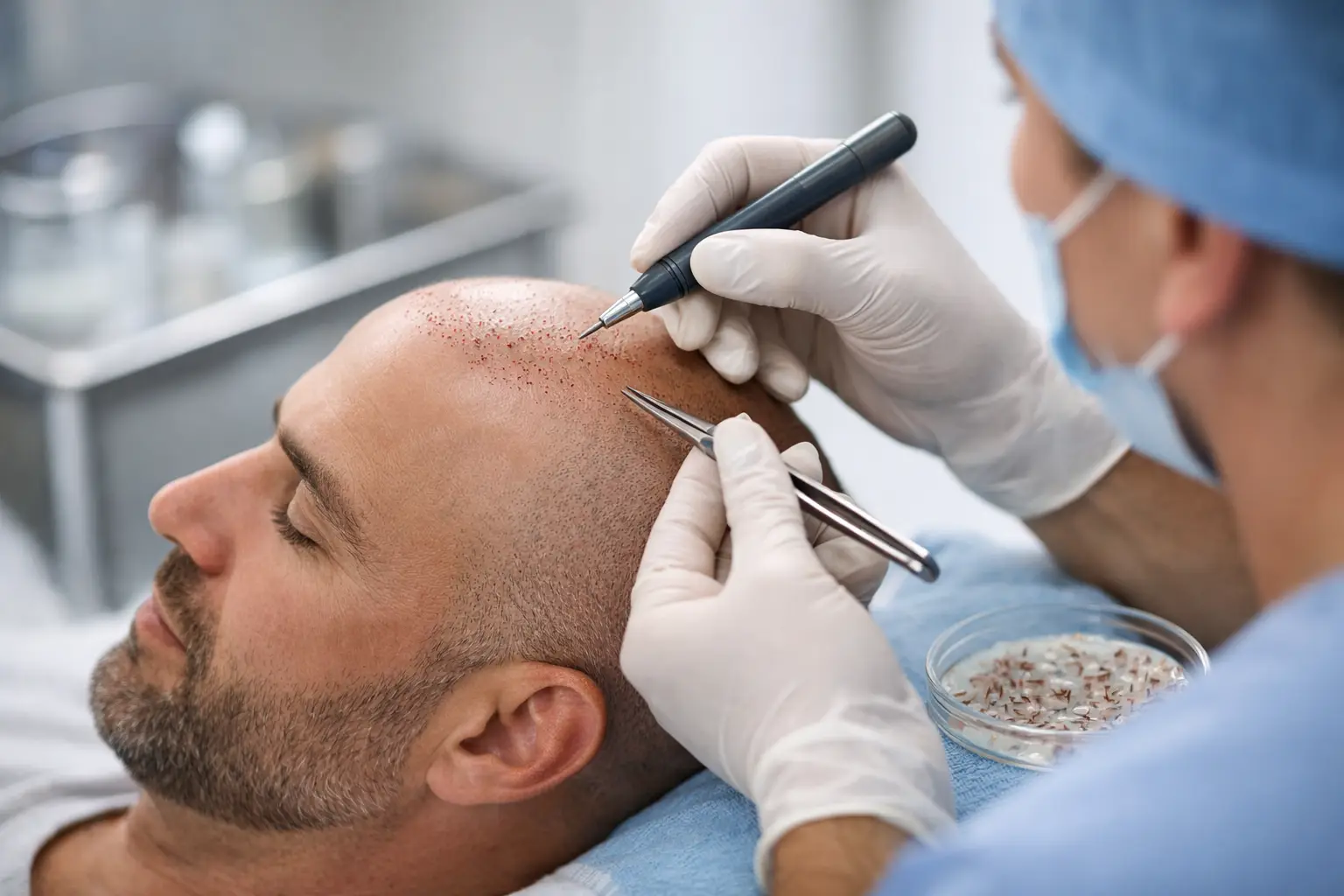
Each follicular unit naturally contains one to four hairs. During FUE, these units are carefully removed using a very small punch tool. The grafts are then prepared and placed into tiny recipient sites created in the thinning area. The angle, direction, and placement matter a great deal because that is what determines whether the final result looks soft and natural or too sharp and artificial.
This is why planning matters as much as technique. A good FUE procedure is not just about moving grafts. It is about designing a hairline that fits your facial proportions, protecting the donor area from overharvesting, and creating density that will still look balanced over time.
Who is a good candidate for FUE?
FUE can work well for both men and women, but not everyone is an ideal candidate in the same way. The best candidates usually have stable donor hair, realistic expectations, and a pattern of loss that can be addressed with available grafts.
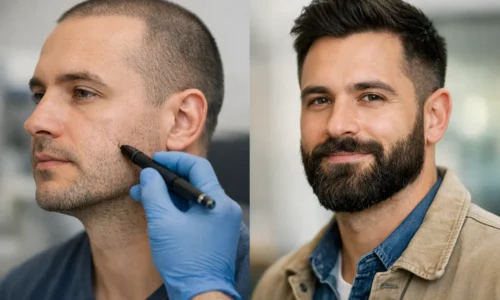
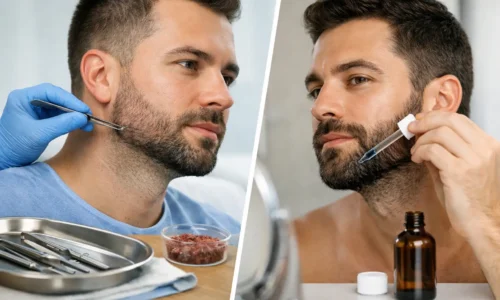
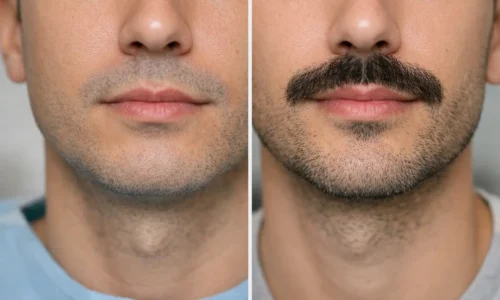
Men with receding hairlines, temple loss, or crown thinning often do well with FUE. Women with localized thinning may also be candidates, although female hair loss patterns sometimes require more careful evaluation because diffuse thinning can affect the donor area too. FUE is also commonly used for beard, mustache, and eyebrow restoration when the donor hair and treatment goals match.
The main question is not simply how much hair you have lost. It is whether you have enough strong donor follicles to create a result worth doing. If hair loss is progressing quickly, your provider may also discuss medical support such as PRP or other hair loss treatments to help protect existing hair alongside the transplant.
What happens before the procedure?
A proper consultation should feel thorough, not rushed. Your provider will assess your scalp, donor density, hair caliber, hair loss pattern, and long-term goals. They should also talk honestly about what FUE can and cannot achieve.
This is the stage where expectations are shaped. Some patients want a very low hairline because they are focused on what they had at 20. In reality, the best outcome is usually an age-appropriate design that looks natural now and still makes sense years from now. Conservative planning often produces the most convincing result.
You may also receive instructions about medications, smoking, alcohol, and scalp care before treatment. These details matter because they can affect healing, bleeding, and graft survival.
What happens during an FUE hair transplant?
On the day of the procedure, the donor area is usually trimmed so the team can clearly access and extract the follicles. Local anesthesia is used to numb both the donor and recipient areas. Most patients describe the procedure as manageable rather than painful, especially after the anesthetic takes effect.
The treatment generally happens in stages. First, the grafts are extracted. Then they are sorted and preserved carefully. After that, the surgeon creates the recipient sites and places the grafts according to the treatment plan.
The procedure can take several hours depending on the number of grafts needed. Smaller sessions may focus on a hairline or a limited area of thinning. Larger sessions can address broader hair loss, but that does not always mean bigger is better. The right graft count depends on your donor supply, the area being treated, and the density that can be achieved safely.
Recovery and healing timeline
Recovery after FUE is usually straightforward, but it still requires care. Tiny scabs form around the transplanted grafts and in the donor area. Mild redness, swelling, and tenderness are common in the first few days.
Most patients can return to desk-based work relatively quickly, although visible signs of treatment may remain for a short time. Strenuous exercise, heavy sweating, and friction on the scalp are usually restricted for a period recommended by your provider. Following aftercare instructions closely helps protect the grafts during the stage when they are most vulnerable.
One part of recovery that surprises many patients is shedding. The transplanted hairs often fall out in the weeks after the procedure. This is normal. The follicles remain in place and enter a resting phase before new growth begins.
You usually need patience. Early growth may start around three to four months, with more noticeable improvement after six months. Final results often continue developing for 12 months, and sometimes longer depending on the area treated.
What kind of results can you expect?
The goal of FUE is natural-looking improvement, not the appearance of suddenly having unlimited hair. Results depend on donor quality, the number of grafts transplanted, hair texture, scalp contrast, and the extent of existing loss.
Thicker, coarser hair often creates better visual coverage than very fine hair. Curly hair can also provide stronger coverage because of the way it sits on the scalp. If the treatment area is large and the donor area is limited, your provider may recommend prioritizing the frontal area first, since that tends to frame the face most effectively.
A successful FUE result should not draw attention to itself. People may notice you look younger, healthier, or more refreshed without being able to identify exactly why. That subtlety is often the sign of good planning and skilled execution.
Benefits of FUE compared with older methods
FUE is popular for good reason. It avoids the linear scar associated with strip harvesting, offers a less invasive experience for many patients, and can be a strong option for those who prefer shorter hairstyles.
It also allows for precise graft selection and can be used beyond the scalp. Facial hair and eyebrow restoration often rely on FUE because individual graft handling is especially important in smaller, detail-focused areas.
That said, FUE is not automatically better in every case. It depends on your scalp characteristics, donor supply, and restoration goals. Some patients need strategic planning more than they need the latest-sounding technique.
Are there any drawbacks or risks?
Like any medical procedure, FUE has trade-offs. It is minimally invasive, but it is still a surgical treatment. Risks can include swelling, infection, folliculitis, uneven growth, poor graft survival, or an unnatural look if the design or placement is weak.
There is also the issue of donor management. Because grafts are taken individually, overharvesting can thin the donor area if the procedure is not planned carefully. This is one reason experience matters so much. A transplant should improve one area without creating a new cosmetic problem in another.
Another practical point is that FUE does not stop future hair loss. If your native hair keeps thinning, you may need medical support or a second procedure later to maintain balance. A trustworthy clinic will discuss this early instead of presenting transplantation as a one-time fix for every case.
How to know if FUE is right for you
The best way to decide is through a personalized assessment. Online research can help you understand the basics, but your scalp, donor area, and pattern of loss are unique. A treatment that works beautifully for one patient may be the wrong fit for another.
If you are considering FUE, focus on three things: whether the clinic specializes in hair restoration, whether the treatment plan feels customized, and whether the expected result sounds realistic. Confidence comes from clarity. You should understand how many grafts may be needed, what density is possible, how recovery will look, and what kind of long-term plan supports your result.
At a specialist clinic such as A H T Aesthetic Medical Center in Dubai, that conversation should be built around your hair characteristics and your goals, not a standard package. The right procedure is the one that respects both your appearance and your future hair loss pattern.
For many people, FUE is not about changing who they are. It is about restoring a hairline, shape, or density that feels familiar again – and doing it in a way that looks natural when life gets close.