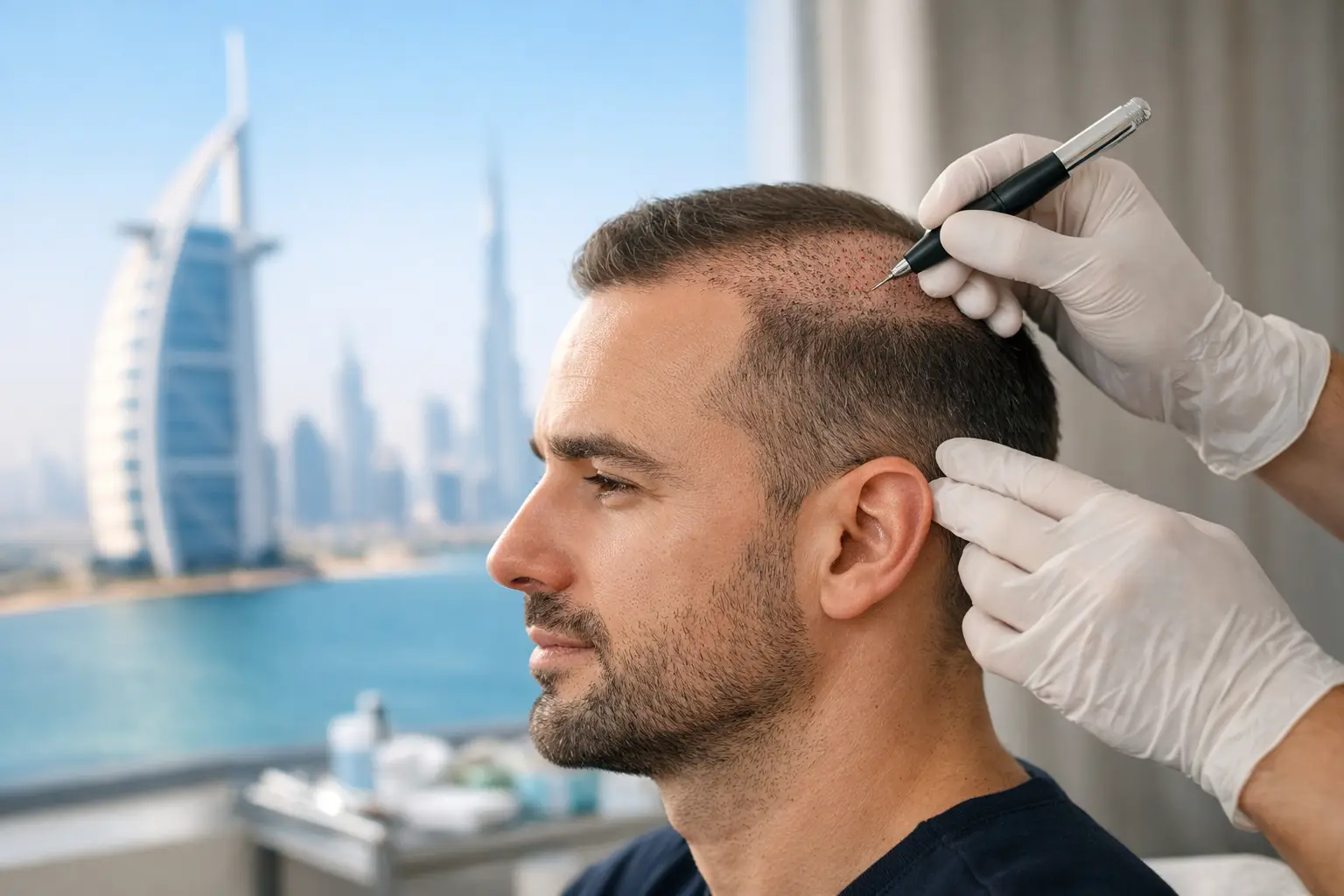
A receding hairline, widening part, or thinning crown can change how you feel in photos, meetings, and everyday conversations. An FUE hair transplant Dubai treatment offers a precise way to restore hair using your own healthy follicles, with a plan designed around your facial features, existing hair pattern, and long-term goals.
For many patients, the decision is not simply about getting more hair. It is about choosing a technique and medical team that can create results that look natural now and continue to look appropriate as you age. That is where careful assessment, conservative hairline design, and experienced graft placement matter.
What Is an FUE Hair Transplant?
Follicular Unit Extraction, commonly called FUE, is a hair restoration technique in which individual follicular units are removed from a donor area, usually the back or sides of the scalp. Each unit may contain one to several hairs. The grafts are then prepared and implanted into thinning or bald areas.
Unlike older strip-based methods, FUE does not require removal of a linear strip of scalp. Instead, it leaves small circular extraction marks that are typically difficult to notice once the surrounding hair grows back. This makes FUE especially appealing to patients who prefer shorter hairstyles or want to avoid a linear scar.
The method is highly detailed. A successful procedure depends on more than extracting grafts. The direction, angle, depth, and distribution of every implanted follicle influence whether the final result blends naturally with your existing hair.
Why Personalized Planning Matters for FUE Hair Transplant Dubai Patients
Hair loss is rarely the same from one patient to another. Some men want to rebuild a mature but fuller hairline. Others need coverage through the mid-scalp or crown. Women may experience diffuse thinning rather than a clearly defined bald area. A treatment plan should reflect those differences.
Before recommending surgery, a qualified medical team evaluates the quality and density of the donor area, the pattern and progression of hair loss, scalp health, hair texture, and family history. Your age also matters. If hair loss is still progressing rapidly, using too many grafts too early may limit options later.
A thoughtful plan protects the donor area while prioritizing the zones that will make the greatest visual difference. In many cases, the hairline and frontal third of the scalp create the strongest improvement because they frame the face. Crown restoration may be included, but it can require a significant number of grafts depending on the size of the area and the desired density.
At AHT Aesthetic Medical Center, treatment planning is centered on natural-looking restoration rather than a one-size-fits-all approach. The goal is to use available donor hair responsibly while creating a result that suits your features and future hair needs.
Sapphire FUE and Standard FUE: Is There a Difference?
Standard FUE refers to the graft extraction method. Sapphire FUE generally describes the use of sapphire blades to create recipient channels before graft implantation. These blades can be made in very fine sizes, allowing the surgeon to make precise incisions that follow the natural direction of hair growth.
For the right patient, Sapphire FUE can support careful graft placement and refined hairline work. However, the instrument alone does not determine the outcome. The medical professional’s skill in designing the hairline, managing grafts, and placing them at the correct angle remains the deciding factor.
Patients should be cautious about promises of guaranteed density or instant transformation. The best technique is the one that fits your donor supply, hair characteristics, degree of loss, and realistic expectations. A consultation should explain why a specific method is being recommended for you.
What Happens During the Procedure?
An FUE procedure is performed under local anesthesia, so patients are awake but comfortable. The donor area is usually trimmed to allow accurate extraction. Individual grafts are removed using specialized instruments, then kept in controlled conditions while the recipient area is prepared.
The next stage is often the most artistic and technical part of the procedure. Recipient channels are created in a pattern that follows your natural hair growth. Single-hair grafts are commonly placed along the hairline for a softer appearance, while grafts containing multiple hairs can add coverage behind it.
The length of the appointment depends on the number of grafts needed. Larger sessions can take several hours. Your medical team will provide instructions on meals, breaks, and what to expect throughout the day so you can feel prepared rather than rushed.
Recovery: What the First Months Really Look Like
Recovery after FUE is manageable for most patients, but it requires patience and careful aftercare. Mild redness, swelling, tenderness, and tiny scabs in the recipient area are expected during the first several days. The donor area can also feel sensitive temporarily.
You will be given specific washing instructions and advice about sleeping position, sun exposure, exercise, and headwear. It is essential to avoid rubbing, scratching, or dislodging newly implanted grafts during the early healing period. Most patients can return to light daily activities within a few days, although strenuous exercise should be delayed according to medical guidance.
One point that often surprises patients is shedding. Transplanted hairs commonly shed in the weeks after surgery. This is a normal phase of the growth cycle and does not mean the grafts have failed. New growth generally begins over the following months, with visible improvement building gradually.
Most patients start to see early new growth around three to four months. Results become more noticeable between six and nine months, while the full maturation of texture, density, and coverage can take 12 months or longer. The timeline varies with the treatment area, individual healing, and hair growth cycle.
Who Is a Good Candidate?
FUE may be suitable for men and women with stable hair loss, adequate donor density, and realistic expectations. It can also be considered for patients seeking hairline restoration, scar coverage, beard transplantation, or eyebrow restoration, depending on their donor hair and goals.
A good candidate is not defined only by the amount of hair loss. Medical history, scalp condition, medications, and the cause of thinning must be considered. Hair loss caused by certain autoimmune conditions, active scalp disease, or untreated nutritional and hormonal issues may require medical evaluation before surgical restoration is considered.
Patients with limited donor supply may still have options, but their plan needs to be especially conservative. In some cases, PRP hair therapy or other hair restoration support may be recommended alongside a transplant plan to help maintain and improve existing hair. Surgery restores follicles to selected areas, but it does not stop future thinning in non-transplanted hair.
Questions to Ask Before Choosing a Clinic
The consultation should give you clarity, not pressure. Ask who will perform the key stages of the procedure, how your donor area will be assessed, and how the clinic plans for future hair loss. You should also ask to see relevant before-and-after results that reflect a similar hair type and level of loss.
It is equally valuable to discuss graft estimates honestly. A high graft number is not automatically better. Overharvesting can weaken the donor area, while excessive density in one zone can look unnatural if surrounding areas continue to thin. A responsible treatment plan balances visible improvement with preservation.
Finally, make sure you understand aftercare and follow-up. Clear instructions, accessible medical support, and scheduled progress reviews can make the recovery period less stressful and help protect your investment in the procedure.
A well-planned FUE transplant is a gradual restoration, not an overnight change. When you choose a team that prioritizes medical assessment, natural design, and long-term donor management, you can move forward with greater confidence and a clearer idea of what your own result can achieve.
Ready to explore your hair restoration options?
Complete a free Hair Analysis or book a consultation with AHT Aesthetic Medical Center in Dubai.
Ready to explore your hair restoration options?
Complete a free Hair Analysis or book a consultation with AHT in Dubai.