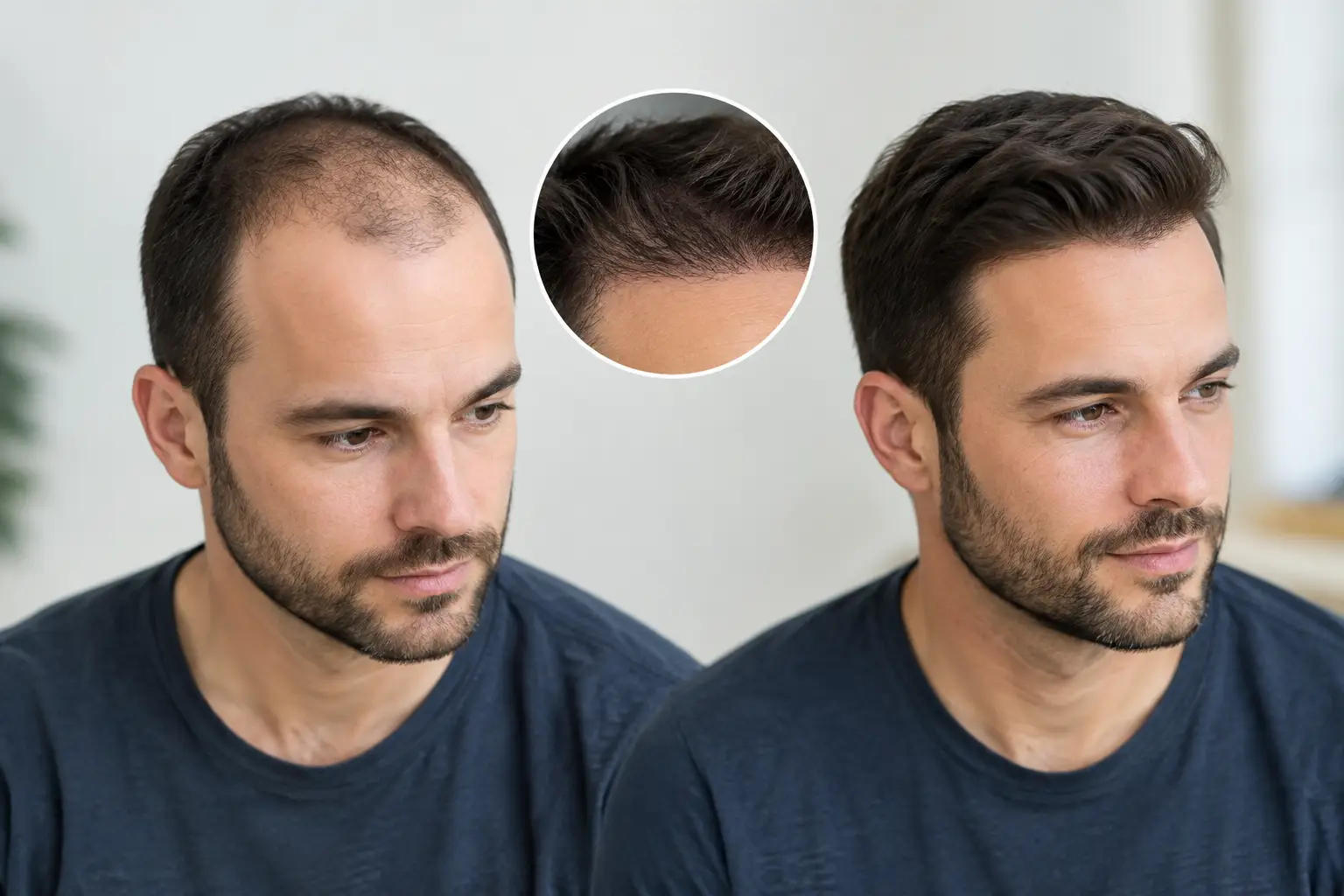
A newly designed hairline can look remarkably natural, but hairline density expectations need to begin with one practical fact: a transplant redistributes your existing donor hair. It does not create unlimited new hair. The goal is not to produce an unnaturally thick, uniform line at any cost. It is to build the appearance of healthy density in a hairline that suits your face, age, hair characteristics, and long-term pattern of hair loss.
For patients considering a hair transplant, that distinction is reassuring. A carefully planned result can restore definition to the face and confidence in your appearance while protecting the donor area and leaving options available if hair loss progresses later.
What Hairline Density Actually Means
Density is often discussed as the number of grafts placed within a specific area of the scalp. That number matters, but it does not tell the full story. Hairline density is also shaped by the thickness of each hair, its natural wave or curl, its color contrast against the scalp, and the angle at which it emerges from the skin.
A person with coarse, wavy hair and low contrast between hair and scalp may create a fuller visual effect with fewer grafts than someone with fine, straight, dark hair against lighter skin. For this reason, two patients can receive a similar graft count and experience very different-looking density.
The front of the scalp also requires a different approach from the crown. At the hairline, the surgeon typically uses single-hair grafts and places them at refined angles to create a soft, irregular transition. This avoids the obvious, plug-like appearance associated with older transplant techniques. Just behind that leading edge, carefully placed multi-hair grafts can add the visual weight needed for a fuller appearance.
Hairline Density Expectations: Natural Beats Maximum Density
It is understandable to bring photos of a previous hairline or a favorite haircut to a consultation. They can help communicate what you hope to achieve. Still, the best transplant plan is not always a return to the exact density or low hairline you had at 18.
A mature, well-proportioned hairline generally ages better and uses donor grafts responsibly. Trying to force a very low hairline or pack excessive density into a large frontal area may require more grafts than the donor supply can safely provide. It may also look less convincing if surrounding native hair continues to thin.
A successful plan balances three priorities: a natural design, meaningful coverage, and preservation of donor hair for the future. This is particularly relevant for younger men whose pattern of hair loss is still developing. In these cases, a conservative design can be a strategic choice rather than a compromise.
For women with hair thinning, expectations may differ. Women often seek improved density through the frontal scalp or part line rather than a lower hairline. The right recommendation depends on whether the thinning is stable, diffuse, hormonal, or related to another underlying cause. A medical assessment is essential before deciding whether transplantation, PRP hair therapy, or another hair restoration approach is appropriate.
How Surgeons Plan a Convincing Hairline
Hairline design is both technical and highly personal. A qualified hair transplant team considers facial proportions, forehead height, temple recession, ethnicity, age, and the likely future course of hair loss. The aim is a hairline that looks as though it has always belonged to you.
At AHT Aesthetic Medical Center, planning begins with an assessment of both the recipient area and donor area. The donor region, usually at the back and sides of the scalp, must have enough stable hair to support the proposed treatment. Hair caliber, density, scalp characteristics, and the quality of individual follicular units all influence what can be achieved.
Sapphire FUE can support precise channel creation and controlled graft placement, but no technique changes the basic biological limits of donor supply. The surgeon’s judgment remains central. Advanced tools are most valuable when used within a thoughtful, personalized plan.
Graft Count Is Not the Same as Coverage
Patients sometimes focus on a single number: “How many grafts will I need?” The answer depends on the size of the area, the condition of existing hair, and the desired degree of visual fullness.
A modest recession may need a different strategy than a hairline restoration combined with diffuse thinning behind it. If native hairs remain throughout the frontal zone, grafts can be used to reinforce that area. If the area is largely bare, more grafts may be needed to establish coverage and visual density. In either situation, placing grafts too closely can risk blood supply to the scalp and may not be medically advisable.
The objective is usually a strong cosmetic improvement rather than identical density to untouched adolescent hair. When grafts are distributed with the right pattern, direction, and spacing, the eye reads the result as fuller than the raw numbers suggest.
Donor Capacity Sets a Healthy Limit
Overharvesting the donor area can leave it looking thin or patchy. That is why responsible donor management matters as much as the appearance of the hairline itself. A treatment plan should preserve a natural look in the donor zone whether you wear your hair short, keep it longer, or require a future procedure.
Patients with extensive hair loss may need to prioritize the frontal hairline and mid-scalp rather than expect dense coverage across every area, including the crown. The frontal frame of the face usually creates the greatest visual impact. A candid consultation should explain this trade-off clearly before treatment.
The Healing Timeline Can Test Your Patience
Early recovery does not reflect the final density. During the first days after a transplant, small scabs form around the implanted grafts. These should be handled exactly as instructed by your medical team. After several weeks, transplanted hairs commonly shed. This temporary shedding phase can be unsettling, but it is a normal part of the growth cycle.
New growth often begins gradually around three to four months, although individual timing varies. By six months, many patients notice clearer change in coverage and hairline definition. Density and hair texture continue to develop over the following months, with final maturation often taking 12 months or longer.
The new hairs may initially appear finer or grow at different rates. This does not mean the final result will remain uneven. As the growth cycles become more established, the hairline usually gains substance and blends more naturally with surrounding hair.
Avoid comparing your progress too closely with another patient’s timeline. Your donor hair, scalp healing, treatment area, and biology are unique. Follow-up appointments give your team the opportunity to assess growth, answer questions, and advise on the next stage of care.
What Can Improve the Appearance of Density
A transplant is only one part of long-term hair restoration. If you still have native hair that may be vulnerable to ongoing thinning, your physician may discuss medical treatments or supportive therapies to help maintain it. PRP hair therapy may be recommended in selected cases as part of a broader plan, depending on your clinical assessment.
Your styling choices also matter once the transplanted hair has grown in. A haircut with measured texture, a slight change in parting, or keeping some length at the front can enhance the perception of density. These are not substitutes for treatment, but they can help you make the most of an already natural result.
Lifestyle and aftercare deserve attention as well. Smoking, poor post-procedure care, and returning to strenuous activity too soon can interfere with recovery. Your clinic should provide clear guidance on washing, sleeping position, sun exposure, exercise, and when to resume grooming routines.
Questions Worth Asking at Your Consultation
A productive consultation should leave you with more than a graft estimate. Ask how your hairline will be designed for your facial structure and age, what density is realistic in your case, and how the clinic will protect your donor area. Ask whether your current pattern suggests a risk of future loss behind the transplanted zone and how that risk affects the plan.
It is also reasonable to ask what the expected timeline looks like, what follow-up care is included, and whether your current hair loss should be stabilized before surgery. Clear answers are a sign of patient-centered planning. Be cautious of promises of instant density, guaranteed outcomes, or a one-size-fits-all hairline.
A well-planned hair transplant should make your reflection feel more familiar, not artificially altered. The right expectation is not perfection under a magnifying glass. It is a natural-looking hairline, meaningful visual density, and a plan designed to support your confidence for years ahead.
Ready to explore your hair restoration options?
Complete a free Hair Analysis or book a consultation with AHT Aesthetic Medical Center in Dubai.
Ready to explore your hair restoration options?
Complete a free Hair Analysis or book a consultation with AHT in Dubai.