The crown is often where hair loss feels most frustrating. It can be hard to style around, easy to notice under bright light, and stubbornly progressive if you leave it untreated. When patients ask about the best treatments for thinning crown, the real answer depends on how much thinning has already happened, how fast it is progressing, and whether the follicles are still active.
Crown thinning is common in both men and women, but it does not respond the same way in every case. Some patients do very well with early medical treatment. Others need a combination approach to slow further loss and rebuild visible density. The key is choosing a plan based on the stage of hair loss, not just the symptom you see in the mirror.
Why crown thinning happens
The crown, or vertex, is one of the most common areas affected by pattern hair loss. In men, this is usually driven by androgenetic alopecia, where genetically sensitive follicles gradually shrink over time. In women, crown thinning can also be linked to female pattern hair loss, hormonal shifts, stress, nutritional issues, or postpartum shedding.
What makes the crown more challenging is that it often thins gradually and diffusely before a clear bald spot appears. By the time many patients notice it, a significant percentage of density may already be reduced. That does not mean the situation is beyond treatment, but it does mean timing matters.
Best treatments for thinning crown based on stage
The best results usually come from matching the treatment to the condition of the follicles. If the hair is miniaturizing but still present, non-surgical options may help preserve and strengthen it. If the area is already sparse or smooth, surgical restoration may be the more effective route.
Prescription medication for early crown thinning
For patients in the earlier stages, medication is often the first line of treatment. In men, finasteride is commonly used to reduce the hormone activity that drives follicle miniaturization. This can help slow loss and, in some cases, improve density over time. Minoxidil is another established option that supports hair growth by extending the growth phase and improving follicle performance.
For women, treatment may involve topical minoxidil and, depending on the medical profile, other hormone-related approaches under physician supervision. This is one area where self-diagnosis can lead to wasted time. A treatment that works well for male pattern loss may not be the right fit for female shedding caused by a different trigger.
The trade-off with medication is patience and consistency. It usually takes several months to judge response, and stopping treatment often means losing the gains. Still, for active follicles in the crown, medication can be one of the most effective ways to slow progression before the area becomes harder to restore.
PRP for thinning at the crown
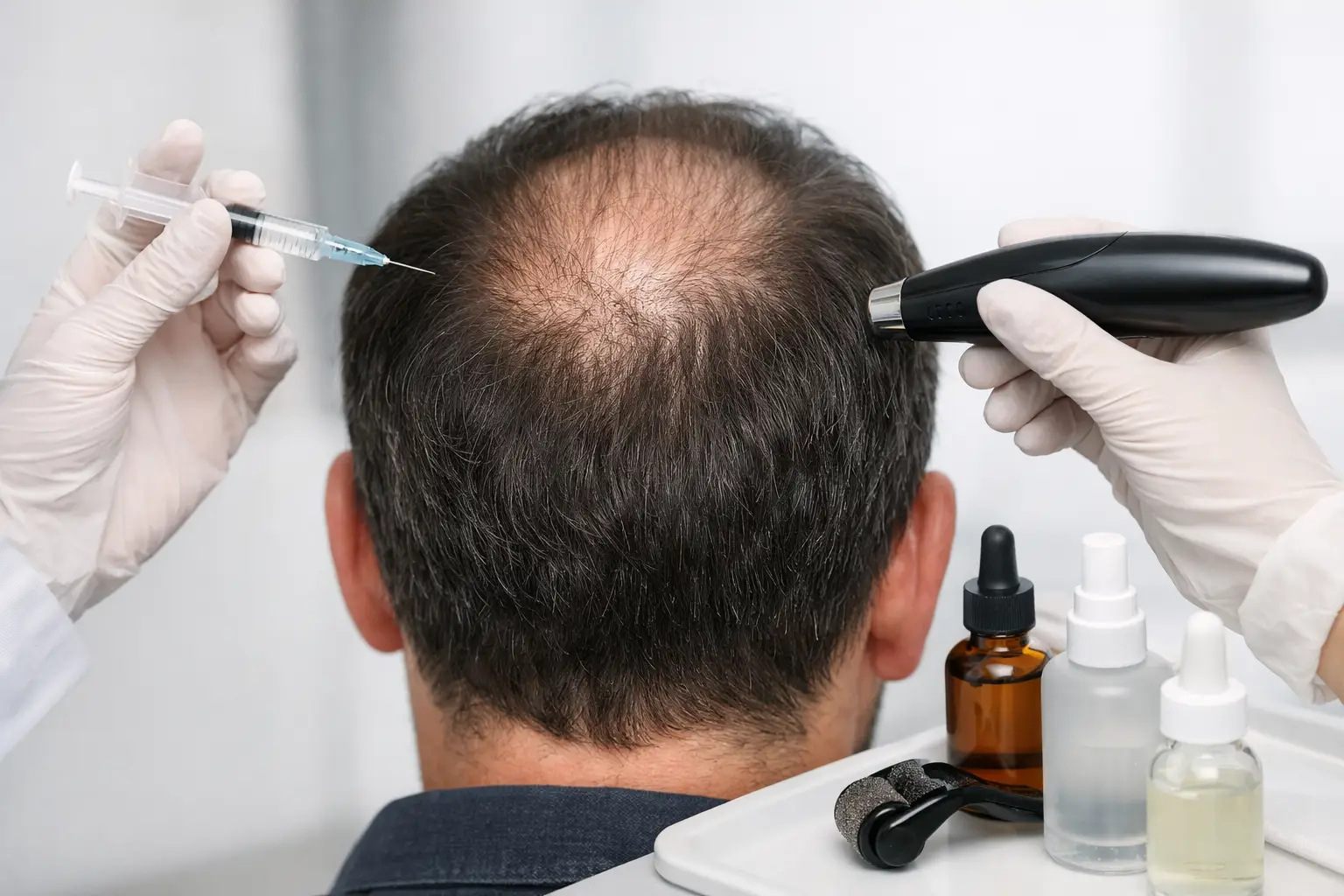
Platelet-rich plasma, or PRP, is a popular option for patients who want a minimally invasive treatment that supports existing follicles. PRP uses concentrated growth factors from the patient’s own blood, injected into the scalp to stimulate weaker follicles and improve hair quality.
PRP tends to work best when there is still hair present in the crown. It is not a replacement for a transplant in an area that has already gone fully bald, but it can be a strong supportive treatment for early to moderate thinning. Many patients choose it as part of a broader plan, especially when they want to improve thickness without surgery.
Results vary. Some patients notice better density and reduced shedding, while others see more modest improvement. That is why realistic expectations matter. PRP is often most valuable as part of combination care rather than a standalone fix.
Hair transplant for advanced crown loss
When the crown has become visibly thin or bald, a hair transplant may offer the most meaningful cosmetic improvement. This is especially true when follicles in the area are no longer producing viable hair and non-surgical treatments are unlikely to restore enough coverage.
Crown restoration requires careful planning. The crown has a natural spiral growth pattern, and creating a result that looks soft and realistic takes experience in angle, direction, and graft placement. It is not only about adding grafts. It is about recreating the pattern of natural density in a way that blends with surrounding hair.
There is also a practical consideration. The crown can require a large number of grafts, and because this area is wide, coverage must be balanced with long-term donor management. In some patients, the front hairline may need to be prioritized first. In others, the crown can be treated effectively in the same session or as a staged plan.
For patients who are good candidates, modern hair transplantation can produce very natural-looking improvement in the crown. It works best when it is designed around both current hair loss and likely future progression.
Combination treatment often gives the best outcome
If there is one pattern specialists see again and again, it is that crown thinning responds best to layered treatment. A transplant may rebuild density, but medication helps protect the surrounding native hair. PRP may improve overall scalp support and strengthen miniaturizing follicles. Used together, these options often produce a stronger and more stable result than relying on one approach alone.
This is particularly important because crown loss can continue to progress. Treating only the visible gap without addressing the ongoing process may lead to uneven density later. A tailored treatment plan helps reduce that risk.
What does not usually work well
Patients often spend months trying shampoos, serums, supplements, and viral home remedies before seeking a medical evaluation. Some products may help scalp condition or improve how the hair feels, but most do not meaningfully reverse pattern-related crown thinning.
That does not mean every non-prescription product is useless. A good shampoo can support scalp health, and correcting nutritional deficiency matters when one is present. But if the concern is true crown miniaturization, cosmetic products alone usually do not stop the process.
Low-level laser therapy may help some patients, especially in mild cases, but it tends to offer incremental improvement rather than dramatic regrowth. It can be worth considering as a supportive option, not as the centerpiece of treatment for more advanced loss.
How to know which treatment is right for you
The best treatments for thinning crown start with a proper scalp and hair assessment. Two patients can look similar in photos and still need very different plans. One may have active miniaturized follicles and respond well to medication and PRP. Another may have long-standing loss with poor follicle activity and benefit more from transplantation.
A good consultation should look at the pattern of thinning, family history, shedding timeline, scalp condition, donor hair quality, and any medical or hormonal factors that may be involved. This is what allows treatment to be customized rather than guessed.
That personalized approach is especially important for patients who want natural results and a realistic roadmap. At a specialist clinic such as A H T Aesthetic Medical Center, treatment planning is built around both hair restoration goals and long-term hair stability, which is what helps patients make decisions with confidence.
When to act
One of the biggest mistakes with crown thinning is waiting until the area is much harder to treat. Early intervention gives you more options and often better non-surgical response. Once follicles have been inactive for too long, regrowth becomes less likely and restoration may require surgery to create visible improvement.
If you have noticed widening at the crown, increased scalp show-through, or difficulty styling the area the way you used to, it is worth getting assessed sooner rather than later. The earlier the plan starts, the more hair there is to protect.
The good news is that crown thinning is treatable, and in many cases, very treatable. What matters most is choosing a solution that fits your stage of hair loss, not chasing generic advice. The right plan can preserve what you have, improve density where it counts, and help you feel like yourself again.