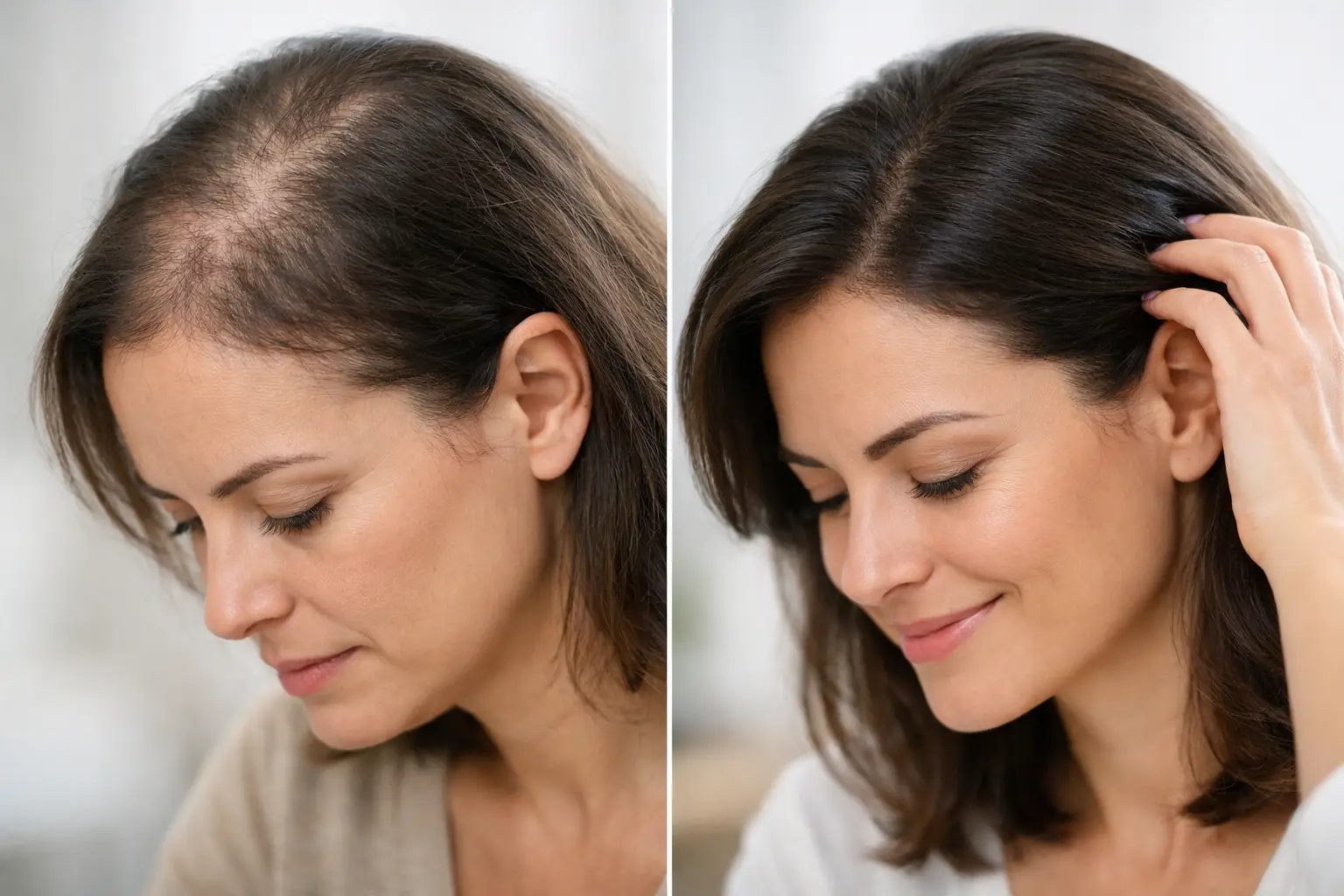
When women search for female hair transplant before after results, they are usually asking a more practical question: will this look natural on me, and will it actually be worth it? The answer depends on the pattern of hair loss, donor hair quality, surgical planning, and patience during the growth cycle. Good before-and-after outcomes are rarely about dramatic shock value. They are about softer part lines, better framing around the face, and density that looks believable in daily life.
For female patients, the standard for success is often different from what you see in male hair restoration. Many women are not trying to create a brand-new hairline or cover a fully bald scalp. More often, they want to improve diffuse thinning, restore temple areas, fill weak spots, or lower a naturally high hairline without making the result obvious. That changes how before-and-after photos should be read.
What female hair transplant before after photos really tell you
A strong before-and-after result should show more than extra hair. It should show improved balance. The frontal hairline should suit the face shape, the density should be placed where it matters most, and the new growth should blend with existing hair rather than sit on top of it.
This is why close-up planning matters. Women often wear their hair in different ways than men, with visible parts, tucked sides, ponytails, and softer framing around the forehead. A result can technically be successful but still feel wrong if the graft placement ignores styling habits. The best outcomes are designed around how the patient actually wears her hair.
Lighting also changes what you think you are seeing. Bright overhead lighting can exaggerate thinning before surgery and flatten density after surgery. Angled photos, makeup, hair fibers, and strategic styling can make a result look stronger than it really is. Honest photos usually show the same angle, similar lighting, wet versus dry hair when relevant, and enough time after surgery for final growth to be visible.
What changes most from before to after
The biggest visual shift is not always thickness across the entire scalp. In many female cases, the most noticeable improvement happens in targeted areas. Filling the frontal band can make the whole head look fuller. Restoring temples can make hairstyles look softer and more feminine. Strengthening the part line can reduce scalp show-through even if total graft numbers are modest.
This is where surgical judgment matters. If grafts are spread too thin across a wide area, the after photo may look only slightly better. If they are concentrated strategically, the result often appears more natural and more satisfying. There is a trade-off between broad coverage and stronger density in priority zones.
Women with traction alopecia, scar-related loss, eyebrow thinning, or localized recession often see clearer before-and-after differences because the treatment area is more defined. Patients with diffuse thinning may still benefit, but expectations need to be calibrated carefully. A transplant adds hair where follicles are placed. It does not stop ongoing miniaturization in untreated native hairs.
Who tends to get the best results
Female hair transplant before after success usually starts with good case selection. Women with stable hair loss, a healthy donor area, and specific areas of concern tend to be stronger candidates than those with widespread unstable thinning.
A thorough assessment should look at the cause of hair loss, not just the appearance of it. Hormonal shifts, nutritional deficiencies, stress-related shedding, traction, autoimmune conditions, and genetic thinning can all present differently. If the underlying issue is still active, transplanting too soon can create a disappointing mismatch between transplanted hair and surrounding hair that continues to thin.
This is one reason medically supervised planning matters. Some patients need treatment to stabilize hair loss before surgery. Others may be better served by combining transplant work with non-surgical support such as PRP-based care or scalp-focused treatment plans. A transplant can be powerful, but it is not always a standalone fix.
The timeline behind before-and-after expectations
One of the biggest misunderstandings around hair restoration is timing. The immediate after phase is not the final result. In fact, the first few weeks can look worse before things improve.
After placement, the grafts settle in and early shedding is common. This stage can be stressful if a patient expects instant fullness. New growth usually starts gradually over the following months, and texture can be fine at first. Real cosmetic improvement tends to build progressively, with stronger maturity later in the process.
That means any female before-and-after comparison should include the time stamp. A six-month result can be encouraging, but it is still early. A twelve-month result is more reliable. In some patients, refinement continues beyond that, especially when longer hair length is needed to appreciate the blend.
What a natural-looking result should include
Natural does not mean low density. It means the result fits. The angle, direction, and distribution of grafts need to match female hair patterns. A harsh, straight, low hairline can look artificial on a woman even if the graft survival is excellent. A softer outline with irregularity in the right places usually looks more convincing.
Hair caliber matters too. Fine hair and coarse hair create different visual density. Curl pattern changes the way coverage appears. Dark hair on light scalp tends to show contrast more than lighter shades. This is why two patients can receive a similar graft count and still have very different before-and-after appearances.
Surgeons who regularly treat women account for these details during design. They are not simply transferring a male transplant template to a female case. The technical approach needs to reflect anatomy, styling, and the patient’s long-term goals.
Why some before-and-after results disappoint
Not every disappointing result comes from poor surgery, but poor planning is a common reason. If the diagnosis is incomplete, if donor supply is overestimated, or if expectations are unrealistic, the after phase can feel underwhelming.
Sometimes the issue is density. Patients may expect the look of naturally dense teenage hair when the safer and more achievable goal is visible improvement. Sometimes the issue is progression. Native hair continues to thin, making the transplant seem less effective over time if maintenance is ignored. And sometimes the issue is design. A technically successful transplant can still feel unnatural if the hairline shape is wrong for the face.
This is why consultation quality matters as much as the procedure itself. A trustworthy clinic will explain what can be improved, what cannot, and whether one session is likely enough.
How to evaluate female hair transplant before after cases wisely
When reviewing cases, look past the headline image. Ask whether the patient had similar hair texture, hair color, and thinning pattern to yours. Notice whether the hair is styled to hide the scalp in the after photo. Check whether the clinic shows multiple angles, including the part line and temples if those are your concern areas.
It also helps to ask practical questions during consultation. How many grafts are being recommended, and why? Is the donor area strong enough? Is your hair loss stable? What kind of density is realistic for your pattern? Will non-surgical support be advised alongside surgery? These questions often reveal more than a polished photo gallery.
For women considering treatment in a specialist setting such as A H T Aesthetic Medical Center, the value is not just in performing the transplant. It is in matching the technique to the cause, pattern, and cosmetic goal so the after result makes sense for real life, not just for the camera.
The emotional side of before and after
For many women, the “before” is not just a visual record. It reflects years of adjusting hairstyles, avoiding bright lighting, changing part lines, and feeling that hair no longer matches how they see themselves. The “after” matters because it can reduce that daily self-consciousness.
That said, the best emotional outcomes usually come when patients expect improvement, not perfection. Hair restoration can make styling easier, increase confidence, and restore lost definition. It cannot recreate every follicle from the past or guarantee identical density in every light.
A thoughtful treatment plan respects both sides of that truth. It aims for visible change, but it stays grounded in what your hair characteristics and donor supply can realistically support.
If you are studying before-and-after results, focus less on the most dramatic transformation and more on the most believable one. The right result should look like your own hair, only stronger, fuller, and easier to live with every day.