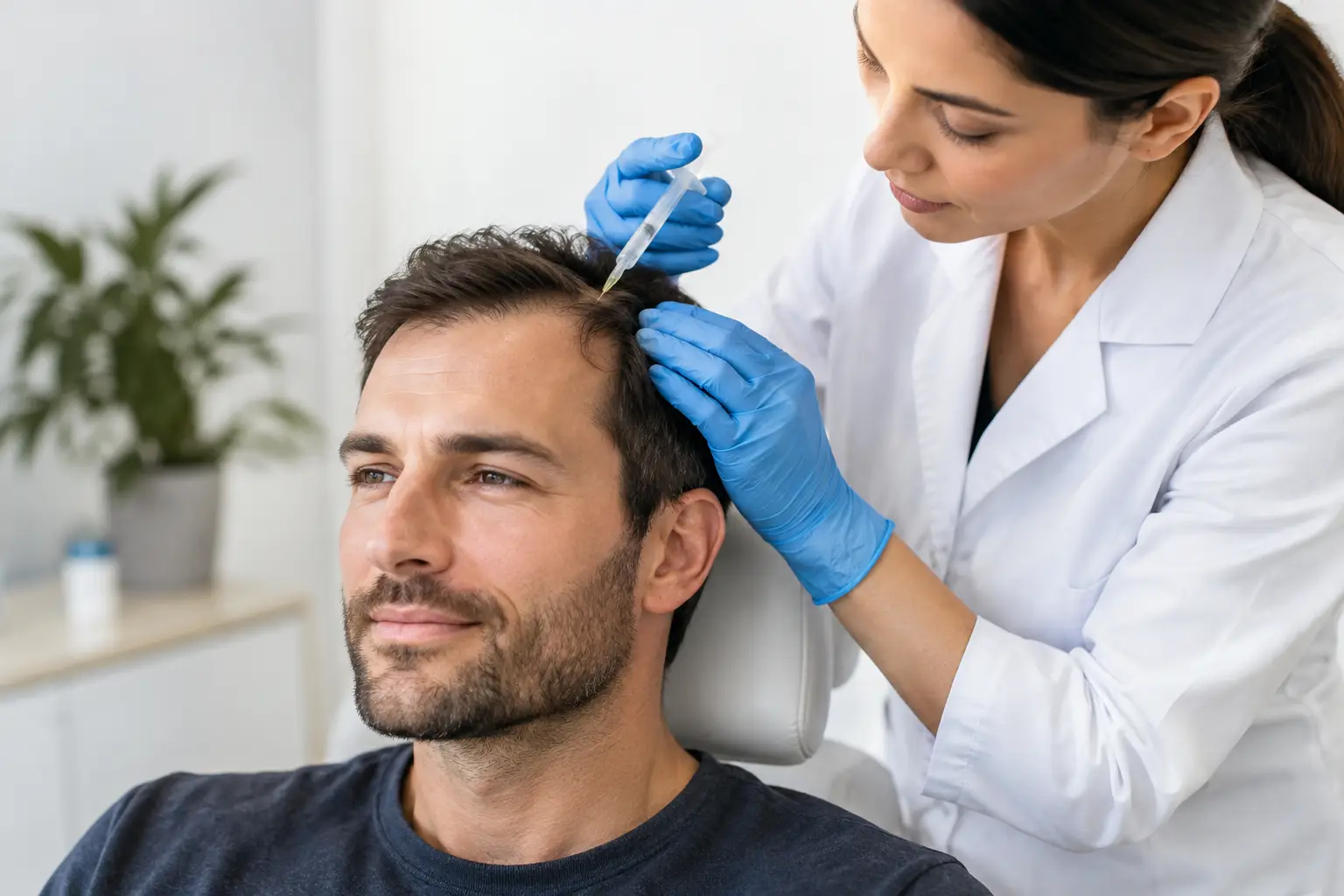
Hair shedding in the shower, a widening part, or a receding hairline can make every mirror check feel more stressful than it should. The best candidates for PRP therapy are often people who notice these changes early and still have thinning, living hair follicles that can respond to stimulation. PRP is not a one-size-fits-all answer, but for the right patient, it can be a valuable part of a personalized hair restoration plan.
PRP hair therapy uses a small sample of your own blood. After the blood is processed, the platelet-rich portion is carefully injected into targeted areas of the scalp. Platelets contain growth factors that may help support follicle activity, improve the scalp environment, and encourage thicker-looking hair over time. The treatment is minimally invasive, performed in the clinic, and requires no surgical incisions.
Who Are the Best Candidates for PRP Therapy?
The strongest candidates usually have early to moderate hair thinning rather than complete, long-standing baldness. PRP works by supporting follicles that are weakened or miniaturized but still present. If an area has been smooth and bald for many years, there may be too few active follicles remaining for PRP alone to produce a meaningful change.
Men with androgenetic alopecia, commonly called male pattern hair loss, may benefit when they have diffuse thinning across the top of the scalp, a gradually receding hairline, or reduced density around the crown. Starting treatment before thinning becomes advanced gives PRP the best opportunity to support the existing hair.
Women with diffuse thinning are also frequently good candidates. Many women first notice a wider part, less volume at the crown, or a ponytail that feels smaller. Because female hair thinning can have several possible causes, a professional assessment is particularly important. Hormonal changes, nutritional deficiencies, thyroid concerns, stress-related shedding, and certain medications can all affect the treatment plan.
Patients Seeking a Nonsurgical Starting Point
PRP can be appealing for patients who want to address hair thinning without immediately committing to surgery. A session typically involves blood collection, preparation of the PRP, and precise scalp injections. Most patients can return to their normal routine quickly, although the scalp may feel tender or appear mildly red for a short time.
This makes PRP a practical option for busy professionals, parents, and medical tourists who want a treatment with limited downtime. It does require patience, however. Hair growth follows a biological cycle, and visible improvement develops gradually rather than overnight.
Patients With Healthy, Active Hair Follicles
A scalp examination helps determine whether PRP is likely to be worthwhile. Candidates generally have visible hairs in the treatment area, even if those hairs have become finer, shorter, or less dense. These are signs that follicles may still be active.
In contrast, patients with extensive scarring, shiny bald areas, or severe follicle loss may need a different approach. A hair transplant may be more suitable when the goal is to restore coverage in areas where follicles are no longer growing hair. In some cases, PRP is used alongside a transplant plan to support the quality of existing hair and the overall scalp environment.
When PRP May Be Part of a Broader Hair Restoration Plan
PRP is often most effective when it is not treated as an isolated procedure. Hair loss can continue if its underlying cause is not identified and managed. A thorough consultation should consider your pattern of loss, family history, medical history, current medications, lifestyle factors, and realistic expectations.
For some patients, PRP may be combined with clinically appropriate medical hair-loss management. For others, it may support results before or after a Sapphire FUE hair transplant. The right combination depends on whether the concern is active thinning, advanced hair loss, poor density in a specific area, or a mixture of these issues.
A patient with early crown thinning may choose PRP to preserve and strengthen existing hair. Someone with a mature hairline recession and stable donor hair may be better served by transplantation, with PRP considered as an adjunct. There is no benefit in promising the same solution to every patient. The treatment should match the condition of the scalp and the result you hope to achieve.
Who Should Wait or May Not Be Suitable?
PRP is derived from your own blood, which reduces the risk of allergic reaction to injected material. Still, it is a medical treatment and is not appropriate for everyone. A clinician should review your health history before proceeding.
Patients may need to postpone treatment if they have an active scalp infection, uncontrolled medical condition, or significant inflammation in the treatment area. Certain blood disorders, platelet abnormalities, severe anemia, or conditions that affect clotting may also make PRP unsuitable or require additional medical clearance.
People taking blood-thinning medication should never stop or change medication on their own to prepare for PRP. Your treating clinician and prescribing physician should determine whether treatment is appropriate and how it can be performed safely. Pregnancy and breastfeeding may also warrant postponing elective hair treatments, depending on individual circumstances and medical advice.
Sudden or severe shedding deserves careful investigation before any cosmetic procedure. If hair loss began rapidly after illness, major stress, weight changes, childbirth, medication changes, or a restrictive diet, the priority may be identifying and addressing the trigger. PRP may still have a role later, but an accurate diagnosis comes first.
What Results Can the Right Candidate Expect?
A successful PRP plan is about improvement, not instant transformation. The goal is commonly to reduce shedding, support stronger hair growth, improve thickness, and create better-looking density in areas where follicles remain active. Results vary according to the cause and stage of hair loss, the quality of the patient’s existing follicles, and adherence to the recommended treatment schedule.
Most protocols involve an initial series of sessions spaced several weeks apart, followed by maintenance sessions when advised. Your provider will tailor the schedule to your hair-loss pattern and response. Some patients notice reduced shedding first, while visible changes in thickness and density often take several months.
Good candidates understand this timeline. They are willing to attend follow-up appointments, follow scalp-care guidance, and allow enough time to assess progress. Clinical photography can be especially useful because gradual changes are easier to see when images are taken under consistent lighting and angles.
Questions to Ask During Your Consultation
Before choosing PRP, ask what type of hair loss you have and whether follicles are still active in the areas that concern you most. Ask how many sessions are recommended, when your progress will be reviewed, and what alternatives would be more appropriate if PRP alone is unlikely to meet your goals.
It is also reasonable to ask who will perform the treatment, how the PRP is prepared, and how the injection pattern is customized for your scalp. A reputable clinic will discuss both the benefits and the limits of treatment clearly. You should leave knowing why PRP is being recommended, not simply that it is available.
At AHT Aesthetic Medical Center, hair restoration planning begins with that individual assessment. The focus is not on selling a standard package, but on identifying the option that gives your existing hair the strongest chance of looking fuller, healthier, and more natural.
The right time to seek advice is usually before thinning becomes advanced. A professional scalp and hair assessment can replace uncertainty with a clear plan, whether PRP is the right next step or another treatment is better suited to your goals.
Ready to explore your hair restoration options?
Complete a free Hair Analysis or book a consultation with AHT Aesthetic Medical Center in Dubai.
Ready to explore your hair restoration options?
Complete a free Hair Analysis or book a consultation with AHT in Dubai.