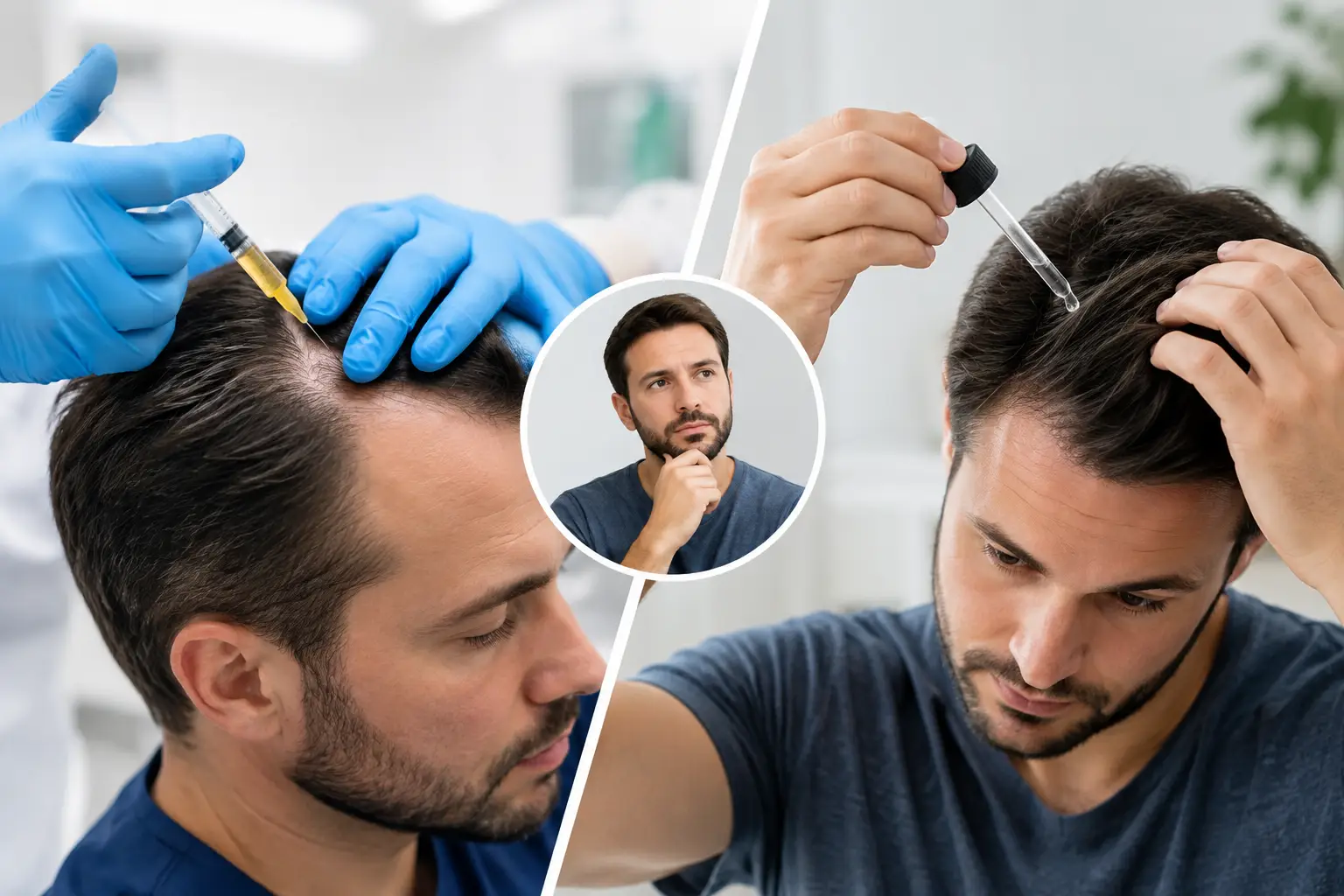
A receding hairline, widening part, or extra shedding in the shower can create understandable urgency. When comparing PRP versus minoxidil therapy, the right answer is rarely about choosing the newest option or the least expensive one. It is about identifying the cause of hair loss, the stage of thinning, and the level of treatment commitment that suits your life.
Both treatments can play a meaningful role in hair restoration, particularly for people experiencing early to moderate pattern hair loss. They work differently, require different levels of consistency, and may be recommended alone or together after a professional scalp and hair assessment.
PRP Versus Minoxidil Therapy: Key Differences
Platelet-rich plasma, or PRP, is an in-clinic treatment that uses a concentrated portion of your own blood. A small blood sample is drawn, processed to separate the platelet-rich plasma, then carefully injected into areas of thinning on the scalp. Platelets contain growth factors that may support follicle activity, improve the scalp environment, and encourage thicker-looking hair in suitable candidates.
Minoxidil is a topical medication applied directly to the scalp. It is commonly available as a liquid or foam and is used regularly at home. Although its exact mechanism is still being studied, minoxidil is believed to help prolong the hair growth phase and increase blood flow around follicles. It can help reduce shedding and improve density for some men and women with hereditary hair thinning.
The clearest difference is the treatment experience. PRP is performed by a trained medical team during scheduled clinic visits. Minoxidil is a daily home-based routine that depends heavily on consistent use. PRP uses your own plasma, while minoxidil is an external medication that remains effective only while it is continued.
How PRP Hair Therapy May Help
PRP is often considered by patients who want a medically supervised, non-surgical option for early thinning or who prefer not to rely exclusively on a daily topical product. It may also be used to support hair quality following a hair transplant, when recommended as part of an individualized recovery plan.
A typical PRP program involves an initial series of sessions spaced several weeks apart, followed by maintenance sessions based on your response and the clinician’s recommendation. Exact scheduling varies. Hair grows slowly, so visible improvement is usually assessed over several months rather than after a single appointment.
The experience is generally manageable. The scalp may feel tender or mildly swollen for a short time after treatment, and some patients notice temporary redness or sensitivity at injection sites. Because PRP is derived from your own blood, the risk of an allergic reaction is low, but proper medical screening still matters. PRP may not be appropriate for everyone, including people with certain blood disorders, active scalp infections, or medical conditions that affect healing.
PRP does not create new follicles in areas where follicles are no longer viable. If there is advanced baldness, a hair transplant may offer a more reliable route to restoring coverage. Even then, PRP can sometimes be considered as supportive therapy for the surrounding native hair.
What to Expect From Minoxidil
Minoxidil is accessible, non-invasive, and easy to begin for many people. It is frequently used for androgenetic alopecia, also known as male- or female-pattern hair loss. The best candidates tend to be those who still have thinning hairs in the affected area, rather than completely smooth areas of long-standing hair loss.
Consistency is the central challenge. Depending on the formulation and medical advice, minoxidil may be applied once or twice daily. Skipping applications regularly can reduce results, and stopping treatment often leads to a gradual loss of the progress achieved. For patients with busy travel schedules, demanding workdays, or irritation from topical products, this daily requirement can become a deciding factor.
Some users experience an initial increase in shedding during the first weeks of use. This can be concerning, but it may reflect hairs shifting through the growth cycle. Persistent or severe shedding should be reviewed by a medical professional rather than simply ignored.
Other possible effects include scalp dryness, itching, flaking, or unwanted facial hair growth if the product spreads beyond the scalp. Foam formulations may be better tolerated by some people, while the most appropriate strength and schedule should be discussed with a qualified clinician, especially for women, patients with heart conditions, and anyone taking other medications.
Which Treatment Delivers Better Results?
There is no universal winner between PRP and minoxidil because results depend on the person, not only the treatment. Age, genetic pattern, duration of thinning, hormone-related factors, scalp health, nutrition, and medical history can all affect the outcome.
Minoxidil can be a practical first step for people with early diffuse thinning who are prepared to use it consistently over the long term. It is also an option for patients who want to begin treatment without injections or clinic visits. Its cost is usually lower at the outset, although it becomes an ongoing expense when used for years.
PRP may suit patients who want an in-clinic treatment plan with direct medical oversight, have not tolerated topical products well, or want to combine therapies for a more comprehensive approach. It requires a higher upfront investment and scheduled appointments, but it does not involve daily application.
For many suitable patients, the strongest plan is not PRP or minoxidil. A clinician may recommend PRP alongside topical minoxidil, depending on the diagnosis and the patient’s comfort level. This combination can address hair loss from different angles, but it should be selected thoughtfully rather than assumed to be necessary for everyone.
The Role of Diagnosis Before Treatment
Pattern hair loss is common, but it is not the only reason hair becomes thinner. Sudden shedding may be related to stress, illness, thyroid changes, iron deficiency, recent weight loss, postpartum changes, medications, or scalp inflammation. Treating these situations as routine pattern loss without evaluating the cause can delay the care you actually need.
A proper consultation should include a discussion of your hair loss history, family history, medications, lifestyle factors, and desired outcome. The scalp should be examined to determine whether follicles are miniaturizing, inflamed, scarred, or inactive. In some cases, laboratory testing or referral for further medical evaluation may be appropriate.
At AHT Aesthetic Medical Center, treatment planning is centered on this individualized assessment. The goal is not to promise identical results for every patient. It is to recommend the option that makes clinical sense for your hair pattern, expectations, and long-term plan.
When a Hair Transplant May Be the Better Option
Neither PRP nor minoxidil can replace hair follicles that have been permanently lost. If the hairline has significantly receded, the crown has extensive bare areas, or density is too limited to meet your cosmetic goals, hair transplant surgery may be the more effective solution.
Advanced methods such as Sapphire FUE are designed to place healthy follicles into thinning or bald areas with careful attention to angle, direction, and density. PRP or minoxidil may still have a role after surgery by helping preserve existing native hair, but they should not be presented as substitutes for transplantation when surgical restoration is the more appropriate path.
The right timing matters. Starting treatment while miniaturized hairs are still present can help protect what you have and may reduce the amount of future restoration needed.
Making a Confident Choice
Choose minoxidil if you are comfortable with a daily routine, have early-stage thinning, and want a non-invasive treatment you can use at home. Consider PRP if you prefer a clinician-led program, want to avoid daily topical application, or are looking for a supportive treatment alongside a broader hair restoration strategy.
If you are unsure where you fit, do not let online before-and-after photos make the decision for you. A careful hair and scalp evaluation can clarify whether PRP, minoxidil, a combination plan, or a hair transplant offers the most realistic path forward. The earlier you address progressive thinning with the right diagnosis, the more options you are likely to have.
Ready to explore your hair restoration options?
Complete a free Hair Analysis or book a consultation with AHT Aesthetic Medical Center in Dubai.
Ready to explore your hair restoration options?
Complete a free Hair Analysis or book a consultation with AHT in Dubai.