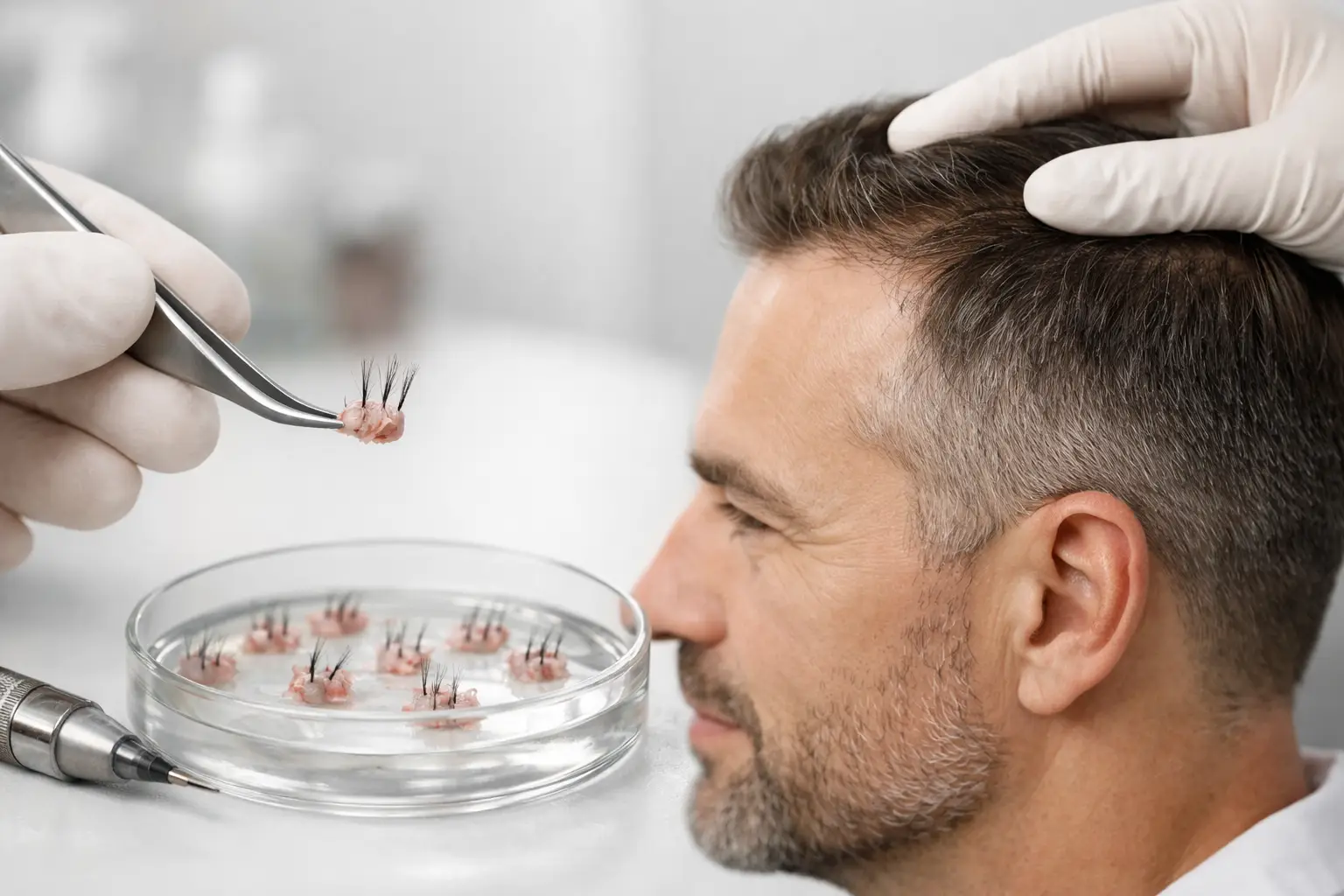
A hair transplant can look either undetectably natural or noticeably overdone, and the difference often starts with the treatment plan. Learning how to choose hair grafts is less about picking a number yourself and more about understanding what that number must accomplish: restore the right areas, protect your donor supply, and create a result that still makes sense years from now.
For men and women considering FUE hair transplantation, graft planning should be personal. Your hairline, hair-loss pattern, hair characteristics, age, family history, and future goals all affect the right approach. A larger graft count is not automatically a better transplant. The best plan is one that creates visible improvement without compromising the long-term health and availability of your donor area.
What Is a Hair Graft?
A graft is a small unit of tissue removed from the donor area, usually the back and sides of the scalp, where hair is more resistant to thinning. Each graft can contain one, two, three, or sometimes four hair follicles. This is why graft count and hair count are not the same thing.
Single-hair grafts are often placed along the front of the hairline and temple areas to create a soft, realistic transition. Grafts containing multiple hairs are typically placed behind the hairline, where they add density and coverage more efficiently. An experienced hair transplant team considers both the number of grafts and the way each type of graft will be positioned.
The goal is not to pack as many grafts as possible into one session. It is to distribute them strategically, with the correct angle, direction, and density for hair that looks like it belongs there.
How to Choose Hair Grafts Based on Your Hair Loss
The first question is not, “How many grafts do I want?” It is, “Which areas need improvement most?” A patient with mild recession at the temples has very different needs from someone with extensive thinning across the frontal scalp, mid-scalp, and crown.
A clinical assessment should identify whether you have a stable pattern of hair loss, ongoing shedding, diffuse thinning, or a combination of concerns. For example, rebuilding a low, dense hairline may require more grafts than expected, but it may not be the most responsible choice for a younger patient whose hair loss is likely to progress. In that situation, a slightly more mature hairline can preserve grafts for future coverage and deliver a more natural result.
For crown thinning, the graft requirement can also be substantial because the area is broad and the hair grows in a circular pattern. Some patients choose to prioritize the hairline and frontal zone first because those areas frame the face and have the greatest impact in conversation, photographs, and professional settings. Others may benefit from a balanced plan that provides moderate coverage across multiple zones. The right decision depends on your pattern, expectations, and available donor supply.
A general graft-count range
While no online estimate can replace an in-person assessment, these ranges can help explain why personalized planning matters:
- Mild hairline recession or small temple restoration may require approximately 800 to 1,500 grafts.
- Frontal hairline and front-scalp restoration may require approximately 1,500 to 2,500 grafts.
- Frontal and mid-scalp thinning often requires approximately 2,500 to 3,500 grafts.
- More advanced loss involving the hairline, mid-scalp, and crown may require 3,500 grafts or more, sometimes planned over multiple sessions.
These figures can change significantly depending on the size of the treatment area, the thickness of your hair, the number of hairs per graft, and the density that can be achieved safely. They should be viewed as planning context, not a promise.
Your Donor Area Sets the Limits
The donor area is one of the most important parts of every hair transplant plan. FUE removes individual grafts from the permanent zone at the back and sides of the scalp. Although this area can provide thousands of grafts for suitable candidates, it is not unlimited.
Removing too many grafts can leave the donor area looking thin, patchy, or uneven. A careful surgeon assesses donor density, scalp flexibility, hair caliber, and the likelihood of future hair loss before recommending a graft count. This is especially important for patients with fine hair, low donor density, diffuse thinning, or a strong family history of advanced baldness.
A responsible recommendation may be lower than the number a patient initially expects. That does not mean the treatment is less effective. It means the plan is designed to protect the appearance of both the transplanted area and the donor area. Long-term results should always take priority over a dramatic but short-sighted transformation.
Hair Characteristics Change What You Need
Two people with the same degree of hair loss may need different numbers of grafts. Coarse hair typically provides more visual coverage than fine hair. Wavy or curly hair can also create an appearance of greater density because each strand occupies more space across the scalp.
The contrast between your hair and scalp matters as well. Dark hair against light skin, or light hair against dark skin, can make thinning more visible. Straight, fine hair with high scalp contrast may require a different density strategy than thick, textured hair with lower contrast.
Your natural hair color, curl pattern, shaft thickness, and existing density all influence how grafts should be allocated. This is one reason a consultation should include a close evaluation of the scalp rather than relying on a standard graft package.
Think Beyond Your First Transplant
A hair transplant redistributes permanent hair. It does not stop non-transplanted hair from continuing to thin. If your existing hair is still weakening, the transplanted area may remain while the hair behind it becomes less dense over time.
For this reason, graft planning should include a conversation about preserving existing hair. Depending on your diagnosis and medical suitability, a physician may recommend a customized hair-loss management plan, PRP or PRF treatments, or other supportive options to improve scalp health and help maintain native hair. These treatments are not a substitute for a transplant when coverage is needed, but they can be valuable parts of a long-term strategy.
Patients in their late 20s or early 30s may need particular caution. Choosing an aggressively low hairline can use a large share of the donor supply before the final pattern of hair loss is clear. A well-designed plan considers how you may look not only after growth appears, but also if you need additional treatment later.
Natural Density Is Different From Maximum Density
Many patients ask for “full density,” but a transplanted scalp rarely matches the density of untouched adolescent hair. The good news is that it does not need to. When grafts are placed thoughtfully, even moderate density can look very convincing.
Natural-looking results depend on more than numbers. The hairline must avoid straight, artificial lines. The grafts need to follow the natural direction of growth. Density should transition gradually from the hairline backward, rather than appearing abruptly concentrated in one area. The frontal zone usually receives the greatest visual attention, while the crown may be planned with a more conservative density to use grafts wisely.
A skilled treatment plan creates the appearance of fullness where the eye expects it most. This approach is often more successful than chasing an unrealistic graft count.
Questions to Ask During Your Consultation
A quality consultation should leave you clear about the recommendation and comfortable with the reasoning behind it. Ask which areas are being prioritized, how many grafts are estimated, and what the plan means for your donor area. You should also ask whether your hair loss appears stable, whether medical hair restoration may be appropriate, and whether a second session could be needed in the future.
It is reasonable to ask how the clinic will design your hairline and how it will prevent overharvesting. Before-and-after photos can be useful when they show patients with hair types and loss patterns similar to yours. Look for natural hairlines, believable density, and donor areas that remain discreet after healing.
At A H T Aesthetic Medical Center in Dubai, graft planning begins with the individual, not a predetermined package. A detailed assessment helps identify the safest path to coverage that complements your facial features, hair characteristics, and long-term goals.
The most reassuring graft recommendation is not necessarily the highest one. It is the one you understand, the one that respects your donor supply, and the one that gives your hair a natural future as well as a stronger appearance today.
Ready to explore your hair restoration options?
Complete a free Hair Analysis or book a consultation with AHT Aesthetic Medical Center in Dubai.
Ready to explore your hair restoration options?
Complete a free Hair Analysis or book a consultation with AHT in Dubai.