Thin brows can change the whole balance of the face. For some people, the issue is a naturally sparse shape. For others, it starts after overplucking, aging, hormonal shifts, a medical condition, or simple genetics. If you are comparing the best eyebrow restoration treatment options, the right answer depends on why your brows thinned, how much density you want back, and whether you are looking for a temporary improvement or a long-term solution.
What matters most is choosing a treatment that matches the cause of the loss. Brow restoration is not one-size-fits-all. A good plan starts with a careful assessment of the hair follicles, the skin, your health history, and the look you want to achieve.
Understanding the best eyebrow restoration treatment options
Eyebrow thinning can happen for very different reasons, and that affects which treatment is likely to work. If the follicles are still active but producing weaker hair, regenerative options may help. If the follicles are damaged or no longer growing hair at all, a transplant may be the stronger option.
This distinction is where many people waste time and money. A serum can support existing growth, but it cannot reliably replace missing follicles. On the other hand, jumping straight to surgery may not make sense if your thinning is mild and responsive to non-surgical care.
Topical growth serums
For early or mild brow thinning, topical serums are often the first thing people try. Some are cosmetic conditioners that improve the look and feel of brow hair. Others are formulated to support the growth cycle and may help existing hairs stay longer, appear thicker, or grow more consistently.
The appeal is obvious. They are easy to use, non-invasive, and relatively low commitment. For patients with thinning rather than complete hair loss, they can be a reasonable starting point.
The trade-off is that results are usually modest and require consistency. If you stop using the product, improvement may fade over time. Serums also work best when follicles are still alive. They are not the ideal answer for scarred areas, long-standing gaps from overplucking, or sections where hair has stopped growing entirely.
PRP and regenerative treatments
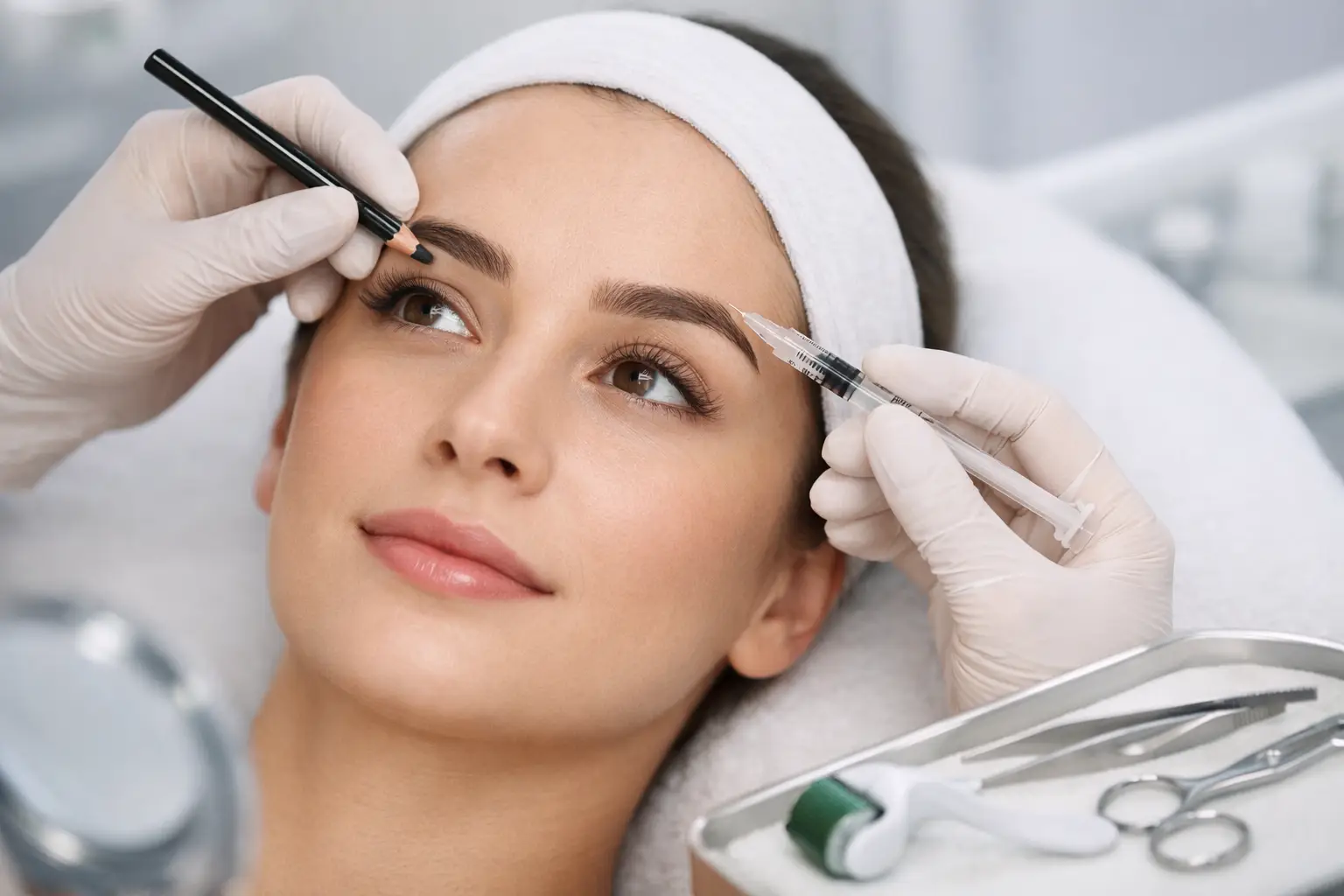
Platelet-rich plasma, often called PRP, has become a popular option for hair restoration and can also be used in the eyebrow area in selected cases. The treatment uses components from your own blood, processed and reintroduced to the treatment area to support follicle health and encourage stronger growth.
For the right candidate, PRP can be especially helpful when brows are thinning but not completely absent. Patients often choose it when they want a medically supervised treatment without surgery. It can also appeal to people who prefer a more natural regenerative approach.
That said, PRP is not a universal fix. It tends to perform better where there is still some follicular activity. Results can build gradually, and most patients need a series of sessions rather than one treatment. It also requires realistic expectations. PRP may improve density and quality, but it is less predictable than transplantation for rebuilding a very sparse brow line.
Some clinics may also recommend PRF or related regenerative approaches depending on the patient’s needs and treatment goals. The principle is similar: support the biology of hair growth rather than simply masking the problem.
Brow makeup and semi-permanent camouflage
Microblading, brow tinting, brow lamination, and cosmetic pencils do not restore hair, but they are still part of the conversation because many patients want a faster visual improvement while deciding on a more definitive treatment.
These approaches can be useful when the shape is uneven or the tails of the brows have faded. Microblading in particular can create the appearance of fuller brows for people who are not ready for a medical procedure.
Still, camouflage is not restoration. Pigment does not behave like real hair, and the result can change over time as the skin changes or the color fades. For patients who want natural texture, movement, and real growth, cosmetic options usually work best as a temporary choice rather than the final answer.
Treating the underlying cause first
Sometimes the best eyebrow restoration treatment options begin with diagnosis, not procedure. Thyroid imbalance, nutritional deficiencies, autoimmune conditions, skin disorders, stress-related shedding, and hormonal changes can all affect brow growth. In these cases, treating the root cause may be necessary before any restoration plan can succeed.
This is an important step, especially if the thinning is sudden, patchy, itchy, or associated with hair loss elsewhere. A medically guided evaluation helps avoid frustration and can prevent you from choosing a treatment that is poorly matched to the problem.
Even if you ultimately decide on a cosmetic solution, understanding the cause improves long-term results. It also helps protect any remaining brow hair.
Eyebrow transplant surgery
For patients with significant loss, permanent gaps, or brows that never developed the density they wanted, eyebrow transplant surgery is often the most definitive option. This procedure uses healthy hair follicles, usually taken from the scalp, and places them strategically into the brow area to recreate shape, fullness, and natural-looking definition.
This is where expertise matters most. Eyebrows are not just small strips of hair. Their direction, angle, softness, and density pattern all affect facial expression. A technically strong eyebrow transplant is designed around those details so the result looks natural at rest and in motion.
The biggest advantage of transplantation is permanence. Once the transplanted follicles establish blood supply and begin growing, they can provide real hair in areas where little or none existed before. This makes the procedure especially valuable for overplucked brows, scar-related loss, naturally sparse eyebrows, or failed cosmetic cover-ups.
The trade-off is that it is still a procedure, even if minimally invasive. There is recovery to consider, temporary shedding after the transplant, and a waiting period before the final result becomes visible. Brow transplants also require careful planning because too much density or poor angle placement can create an unnatural appearance. When performed well, however, they remain one of the strongest long-term solutions available.
Who is a good candidate for each option?
If your brows are mildly thinning and you still have visible hair throughout the area, serums or regenerative treatments may be enough to improve density. If you have patchy loss but active follicles remain, PRP can be worth considering as part of a non-surgical approach.
If your concern is mainly cosmetic and you want immediate visual definition, temporary styling or semi-permanent techniques may help. But if you have clear gaps, old overplucking damage, scar-related loss, or very sparse brows that have not responded to other methods, a transplant is usually the most reliable path to lasting change.
Age, skin condition, hair texture, medical history, and the quality of the donor hair also influence the decision. That is why consultation matters. A treatment that sounds impressive online may not be the one that gives you the most natural result.
What results should you realistically expect?
The best outcomes are the ones that look like your brows, just better. Most patients do not want obviously treated eyebrows. They want more balance, better definition, and a shape that fits their features.
With topical and regenerative approaches, expect gradual change rather than a dramatic overnight shift. With cosmetic camouflage, expect quick improvement but ongoing maintenance. With eyebrow transplantation, expect a longer timeline with the most meaningful long-term payoff.
A strong provider will set realistic expectations from the start. That includes discussing density goals, healing, maintenance, and whether more than one treatment approach makes sense. In some cases, a combined plan is the smartest route, such as improving the health of existing hairs first and then refining shape with transplant work where needed.
Choosing a provider for eyebrow restoration
Because brows frame the eyes and affect facial symmetry, this is not a treatment to approach casually. The provider should understand both medical restoration and facial aesthetics. Technical placement matters, but so does artistic judgment.
Ask how the treatment is customized, whether the result is designed around your face rather than a generic template, and what kind of aftercare support is included. Patients often focus only on the procedure itself, but planning and follow-up are what help turn a good result into a great one.
At a specialist clinic such as A H T Aesthetic Medical Center, the advantage is a more tailored approach to restoration, with attention to natural hair direction, minimally invasive techniques, and a result that supports overall facial harmony rather than simply adding more hair.
If your brows have become a daily source of frustration, the good news is that you are not limited to pencils and guesswork anymore. The right treatment can restore more than shape – it can restore ease, confidence, and the feeling that your reflection makes sense again.