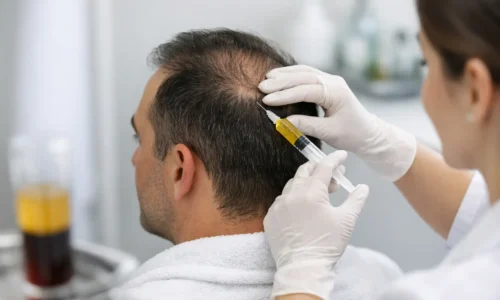
The temples are often the first place hair loss becomes hard to ignore. You may still have decent density through the top, but those corners start pushing back, your hairline loses its shape, and styling gets less forgiving. If you are wondering how to treat receding temples, the right answer depends on why it is happening, how far it has progressed, and whether your goal is to slow it down, regrow hair, or rebuild the hairline.
Why temple recession happens
Temple thinning is most commonly linked to androgenetic alopecia, also called pattern hair loss. In men, it often starts with a gradual M-shaped hairline. In women, the pattern can be more subtle, but the temples may still lose density and create visible gaps around the frontal hairline.
Hormones are usually part of the picture, especially sensitivity to DHT, which can shrink hair follicles over time. But they are not the only factor. Chronic stress, nutritional deficiencies, traction from tight hairstyles, postpartum shedding, thyroid imbalance, and inflammatory scalp conditions can all contribute to thinning at the temples.
That is why self-diagnosing can be misleading. Two people may have the same-looking recession with very different causes and very different treatment plans.
How to treat receding temples based on the cause
The first step is not choosing a trendy product. It is confirming what is actually driving the hair loss. A proper assessment usually looks at pattern, scalp condition, family history, rate of shedding, and whether miniaturized hairs are still present in the temple area.
If follicles are weakened but alive, non-surgical treatment may help preserve and sometimes improve density. If the area has been bare and inactive for a long time, medical therapy alone is less likely to rebuild a clean temple line. In those cases, restoration may require a procedural approach.
When medication may help
For many patients with early or active pattern hair loss, medication is the foundation. Minoxidil is commonly used to stimulate follicles and extend the growth phase. Some patients respond well, especially when treatment begins early, but temple regrowth tends to be less predictable than crown regrowth. It can still be worthwhile because stabilizing further loss matters just as much as gaining density.
For men, finasteride may be recommended to reduce DHT-related miniaturization. This can be effective for slowing progression and preserving hair that is at risk. The trade-off is that not every patient is comfortable taking oral medication, and suitability should be reviewed with a qualified medical professional.
Women may need a different plan depending on hormonal profile, age, pregnancy considerations, and the broader cause of thinning. That is one reason generic online advice often falls short.
PRP, PRF, and regenerative treatments
If the temple area still has thinning hairs, regenerative treatments can be useful as part of a medically supervised program. PRP and PRF use your body’s own growth factors to support follicle health and improve scalp environment. In the right patient, these treatments may strengthen miniaturized hairs, improve quality, and support better density over time.
Exosome-based therapies are also gaining attention in hair restoration because they aim to support cellular repair and regeneration. These options are not magic fixes, and they work best when there are viable follicles to support. They are often used alongside medication rather than as a replacement for it.
This is where expectations matter. Regenerative treatments can improve weak hair, but they do not create new follicles in completely bald skin.
Can temple hair grow back naturally?
Sometimes, but only in specific cases. If the recession is related to temporary shedding, stress, postpartum changes, low iron, crash dieting, or traction from tight hairstyles, hair may improve once the trigger is addressed. Even then, regrowth can take several months, and the results may be incomplete if the damage has been prolonged.
If the issue is established pattern hair loss, waiting for natural regrowth usually leads to more recession, not less. Temple loss is often progressive. Early treatment generally offers the best chance of keeping the original hairline for longer.
Hair transplant for receding temples
When patients want to rebuild temple points or restore a more youthful frontal frame, a hair transplant is often the most definitive option. This is especially true when the area has become visibly bare or when the hairline shape has changed enough that styling no longer disguises it.
FUE hair transplant is commonly used for temple restoration because it allows precise placement of individual grafts. The temple region requires careful angling, density planning, and artistic restraint. Too many grafts, the wrong direction, or a hairline designed too aggressively can look unnatural.
That is why temple work is not just about filling space. It is about recreating the soft transition and natural geometry of the original hairline.
Who is a good candidate?
A good candidate usually has stable donor hair, realistic expectations, and a pattern of loss that can be planned around. Age matters, but not in a rigid way. A younger patient with rapidly progressing hair loss may need a more conservative design and a long-term strategy, while an older patient with stable recession may be ready for a focused transplant approach.
Most importantly, surgery should fit into an overall hair loss plan. If ongoing native hair is still miniaturizing, treating the temples alone may not be enough.
What results can you expect?
Transplanted temple hair does not appear overnight. Shedding after the procedure is normal, and visible growth builds gradually over several months. Final refinement takes time. The payoff is that, when performed well, the result can restore facial balance and create a natural-looking improvement that does not depend on daily camouflage.
What does not work well for receding temples
This is where many patients lose time and money. Oils, shampoos, supplements, and social media hacks are often marketed as universal solutions, but temple recession is not a simple dryness problem or a scalp circulation problem. If the follicles are DHT-sensitive or already inactive, surface-level products alone will not reverse that process.
That does not mean every non-prescription product is useless. Some can support scalp health or reduce breakage. But supportive care is different from true treatment. If your temples are steadily moving back, relying on cosmetic products alone usually delays more effective intervention.
When to seek professional evaluation
The best time to act is when you first notice shape changes in the hairline, increased visibility at the corners, or more scalp showing under bright light. Hair loss treatment is often more successful when follicles are weakened rather than gone.
You should also seek evaluation if temple thinning is sudden, patchy, itchy, inflamed, or accompanied by excessive shedding. Those signs can point to causes beyond standard pattern loss and may require a different medical response.
At a specialized center such as A H T Aesthetic Medical Center, the focus should be on identifying whether you need preservation, stimulation, restoration, or a combination of all three. The right plan is rarely one-size-fits-all.
How to choose the right treatment plan
A strong treatment plan balances short-term improvement with long-term maintenance. If you still have miniaturized hairs, preserving them matters. If the temple area is already empty, rebuilding may require transplantation. If your scalp health is poor or the shedding is active, that needs attention before expecting meaningful cosmetic change.
Cost, downtime, and tolerance for ongoing treatment also matter. Medication may be cost-effective and practical for some patients, while others prefer a procedural solution because they want a more defined structural change. Neither approach is automatically better. The best option is the one that matches your diagnosis, your goals, and the stage of hair loss.
A realistic path forward
Temple recession can make you look older, more tired, or less polished than you feel, and that is exactly why so many people start researching it early. The good news is that there are effective options. The less helpful truth is that timing and diagnosis matter more than marketing.
If you want the best chance of improving receding temples, treat it as a medical and aesthetic issue, not just a grooming problem. A personalized plan made early can protect existing hair, improve density where follicles are still active, and restore the hairline when a lasting correction is needed. The sooner you get clarity, the more choices you usually have.