Reduce Forehead Height
Selected patients may achieve a visually shorter forehead through frontal graft placement.
Hairline lowering through hair transplantation may help selected men and women reduce the appearance of a high forehead, rebuild recessed temples and improve facial proportions while preserving a natural transition zone.
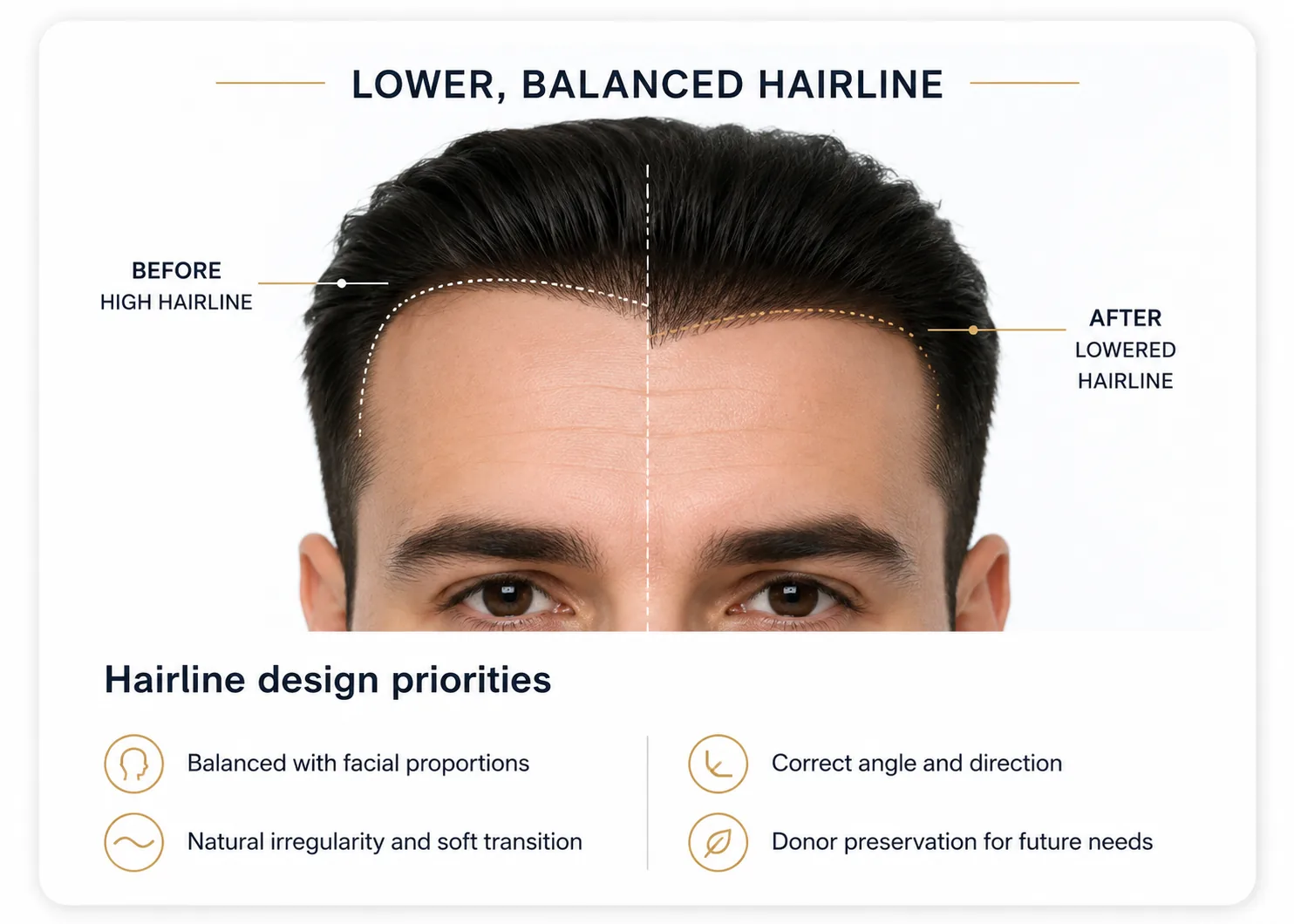
Selected patients may achieve a visually shorter forehead through frontal graft placement.
Temple points and corners can be rebuilt where recession has changed facial framing.
Hairline position is designed around forehead, brow and overall facial proportions.
Single-hair grafts are typically used at the leading edge for a softer appearance.
Rounded, mature or feminine patterns can be discussed according to anatomy and goals.
Donor limits and possible future hair loss remain part of the design decision.
Forehead height, donor area and hair-loss pattern are reviewed.
The new hairline is mapped according to facial proportions.
Follicular units are collected from the donor area.
Angles and density are planned across the new frontal zone.
Grafts are placed to create a natural transition.
The position depends on facial proportions, donor supply and long-term hair-loss planning.
Naturalness depends on design, single-hair graft placement, angle and density control.
Yes, selected women with a naturally high forehead or stable frontal thinning may be assessed.
Temple restoration may be included when donor supply and facial anatomy allow.
No. Hair transplantation lowers the visual hairline with grafts; forehead-reduction surgery is a different procedure.
Send clear photos and book your consultation with AHT Dubai.