If you have been quoted 2,000 grafts by one clinic and 3,500 by another, you are not comparing simple numbers. You are comparing planning philosophies. A complete guide to hair graft planning starts there – because graft planning is not just about filling empty areas. It is about using a limited donor supply wisely, designing for your face and age, and creating results that still look natural years from now.
Hair graft planning is one of the most important parts of any transplant, yet it is often the least understood by patients. Many people focus on the total graft number as if more automatically means better. In reality, the right number depends on your donor capacity, hair characteristics, pattern of loss, and long-term goals. Good planning protects both appearance and future options.
What hair graft planning actually means
A graft is a naturally occurring group of hairs taken from the donor area, usually the back and sides of the scalp. One graft may contain one hair, two hairs, three hairs, or sometimes more. That matters because 2,500 grafts do not equal 2,500 hairs. The final visual result depends on both graft count and the average number of hairs in each graft.
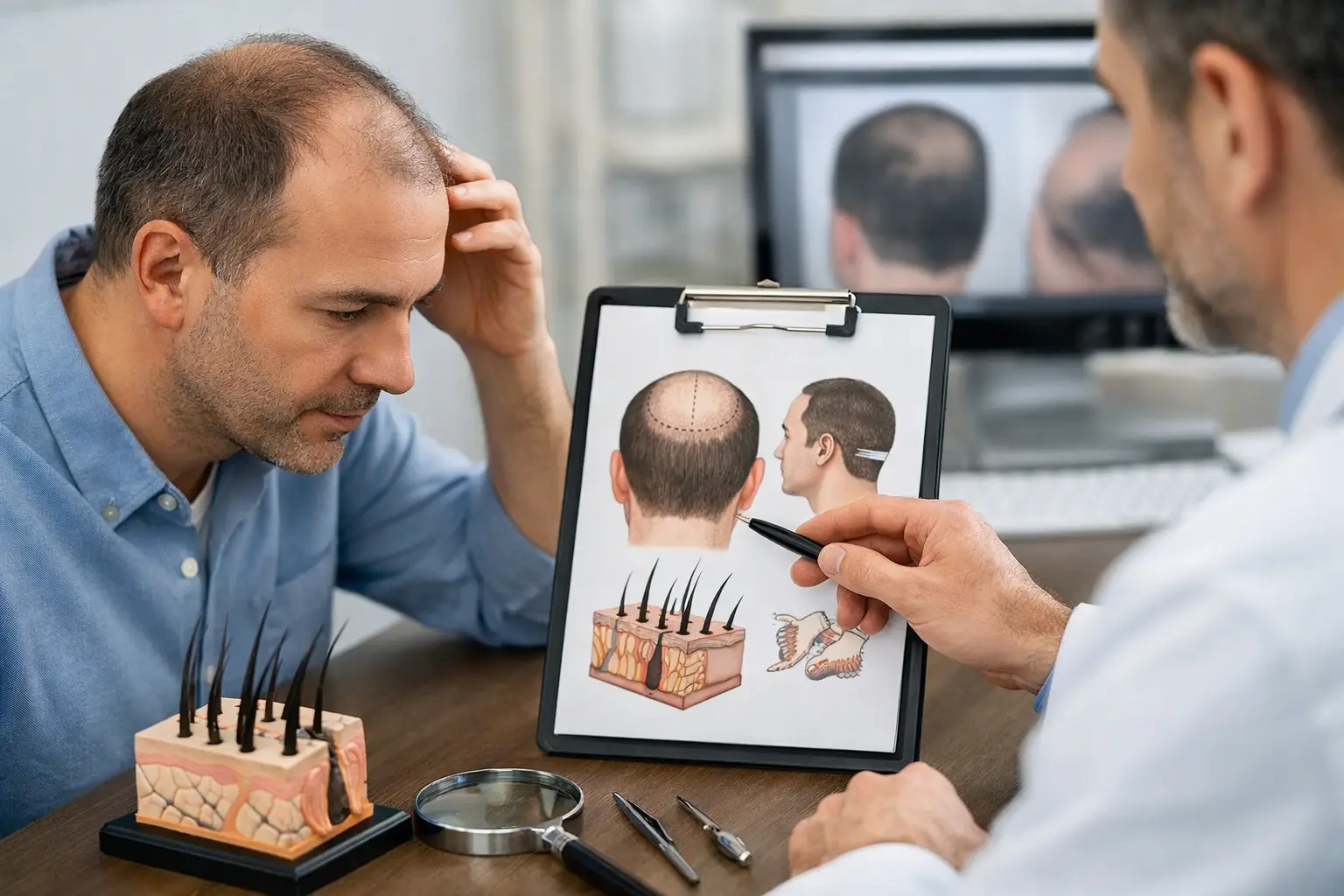
Planning means deciding where those grafts should go, how densely they should be placed, and how much donor supply should be preserved for the future. It also means matching the design to the type of restoration you need, whether that is a scalp transplant, beard transplant, mustache transplant, or eyebrow work. Each area has different density targets and aesthetic rules.
The complete guide to hair graft planning starts with diagnosis
Before any grafts are counted, the reason for hair loss needs to be understood. Male pattern baldness, female pattern thinning, traction alopecia, scarring, hormonal changes, and temporary shedding all call for different strategies. A patient with active hair loss may need a medical stabilization plan before surgery is even considered.
This is where careful assessment matters. If native hair is still miniaturizing quickly, transplanting into the area without addressing progression can create an uneven look later. In some cases, surgery is appropriate now. In others, it is smarter to treat the hair loss first and reassess.
An experienced team also studies the pattern of loss rather than just the area that bothers you most today. Someone focused on the front hairline may also have gradual crown thinning that affects the long-term plan. If all available grafts are used in one zone, future correction becomes harder.
How doctors estimate the number of grafts needed
Graft planning usually begins with surface area. The larger the balding or thinning zone, the more grafts may be required. But surface area alone is not enough. The target density matters just as much.
A natural-looking result does not always require recreating the density you had as a teenager. In fact, trying to do that is often unrealistic and can waste donor grafts. The goal is cosmetic density – enough coverage to create the appearance of fullness in normal social settings. This varies depending on the location. The frontal hairline often needs more strategic precision, while mid-scalp and crown planning may involve lower density with smart distribution.
Hair characteristics can change the math significantly. Thick hair generally provides more visual coverage than fine hair. Wavy or curly hair often covers better than very straight hair. Dark hair against a light scalp can make thinning more noticeable, which may increase the need for coverage. Light hair on a similar-toned scalp may require fewer grafts for a pleasing result.
Donor area quality is the real limiting factor
Most patients think about the recipient area first, but the donor area is what sets the boundaries. Your donor region is not unlimited. Every graft moved from the back or sides must be harvested carefully so the donor area still looks natural.
Strong donor density gives more flexibility. Lower donor density requires a more conservative plan. The same is true for hair shaft thickness, scalp laxity in strip cases, and the stability of the donor zone itself. If the donor area is overharvested, even a technically successful transplant can leave visible thinning behind.
That is why responsible graft planning does not promise the highest possible number on day one. It balances present needs with future realities. For younger patients especially, preserving donor reserves can be just as important as improving the current hairline.
Hairline design is where numbers meet aesthetics
A hairline should not be planned in isolation from the face. It needs to suit your age, facial proportions, ethnicity, gender, and expected future hair loss. A low, aggressive hairline may look appealing in a consultation photo, but it can be difficult to maintain naturally over time and usually demands more grafts.
Single-hair grafts are often used at the front edge to create softness. Behind that, multi-hair grafts can build density. This is one reason planning is more complex than assigning one uniform graft count across an area. Placement, angulation, direction, and transition zones all affect whether the result looks natural.
For women, planning often differs because the concern may be diffuse thinning rather than a receding pattern. For beard or eyebrow restoration, graft selection and placement become even more exact. Eyebrow work, for example, uses smaller numbers of grafts but requires exceptional directional control.
Why two patients with similar hair loss can need different plans
No honest complete guide to hair graft planning should imply there is one standard formula. Two people with similar visible baldness can receive very different recommendations, and both can be correct.
One patient may have coarse, wavy hair and excellent donor density, making broader coverage possible with fewer grafts. Another may have fine, straight hair and limited donor reserves, requiring a staged approach. One may prioritize a stronger front hairline. Another may prefer wider overall coverage. Age also changes the discussion. A man in his early 30s with progressive loss should usually plan differently from a man in his late 40s with a more established pattern.
This is why online graft calculators can only offer rough estimates. They cannot assess donor quality, facial balance, hair caliber, or long-term planning.
Single session or staged treatment
Some patients can achieve their goals in one session. Others are better served by staging treatment over time. This is common when the area of loss is extensive, donor supply is moderate, or the goal is to refine density after the first procedure.
A staged plan can be the more conservative and natural choice. It allows healing, lets the first session grow in fully, and gives the medical team a clearer picture of what still needs improvement. It also helps avoid overcommitting grafts too early.
There is a trade-off, of course. Multiple sessions require more patience and a longer timeline. But for the right patient, they can produce a better overall result and preserve more flexibility.
Common mistakes in graft planning
One of the biggest mistakes is treating graft count as a sales number rather than a medical decision. Bigger numbers sound impressive, but more is not always better if the donor area cannot support it or if the design is poorly conceived.
Another mistake is chasing density in the crown before securing the frontal zone. The crown can consume a large number of grafts, and its swirling growth pattern often requires thoughtful prioritization. Many patients benefit more from focusing first on the hairline and mid-scalp because those areas frame the face.
Poor planning also happens when future hair loss is ignored. A transplant should fit not only your current appearance but also the likely direction of your hair loss pattern. When that is overlooked, the result can appear isolated or unnatural as surrounding native hair continues to thin.
What to ask during a consultation
A strong consultation should explain why a certain graft range is recommended, not just present a number. You should understand how your donor area was assessed, what density goals are realistic, and how the plan may change if hair loss progresses.
Ask whether your result is expected in one session or stages. Ask how the hairline design was chosen for your face and age. Ask what part of the scalp is being prioritized and why. If the answers are vague or heavily focused on selling volume, that is worth noticing.
At a specialist clinic such as A H T Aesthetic Medical Center, the value of planning is not only technical. It is also personal. The best plans reflect your appearance goals, your lifestyle, and how much change you want to see without sacrificing a natural look.
The goal is not maximum grafts – it is the right result
Patients often come in asking, “How many grafts do I need?” The better question is, “What plan gives me the most natural and sustainable result?” That shift matters. A well-planned transplant respects the limits of your donor area, accounts for future loss, and focuses on visible improvement where it counts most.
If you are considering treatment, the smartest next step is not to chase the largest quote. It is to get a careful medical assessment and a plan built around your hair, your face, and your future.