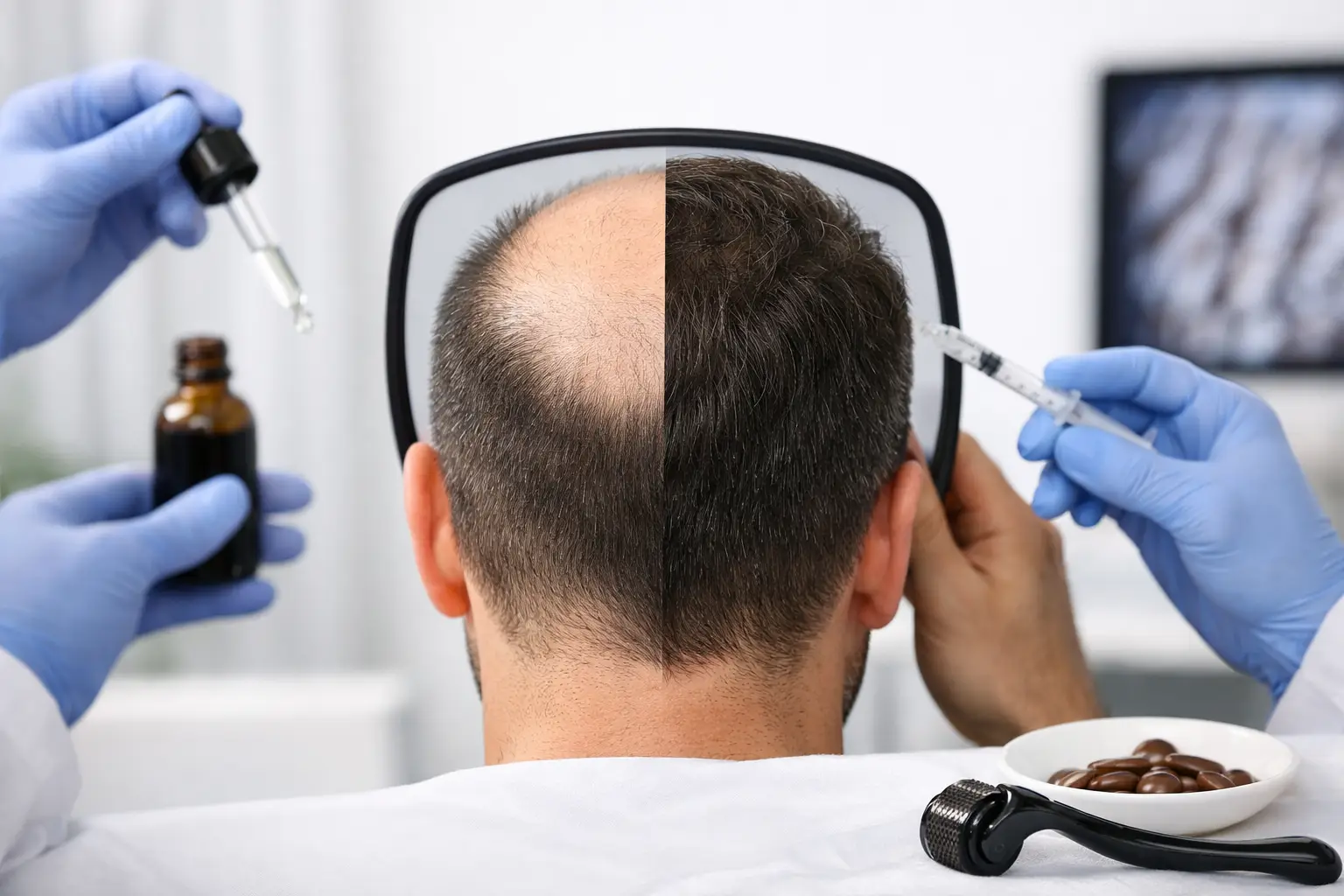
A male pattern baldness treatment example is most useful when it reflects a real clinical principle: the right plan depends on your pattern of loss, donor hair quality, age, family history, and expectations. A man noticing a receding hairline at 28 needs a different approach from someone in his late 40s with advanced thinning across the crown. The goal is not simply to add hair. It is to protect what you have, restore what has been lost where appropriate, and create a natural-looking result that will continue to suit you over time.
Why male pattern baldness needs a tailored plan
Male pattern baldness, also called androgenetic alopecia, usually develops in a recognizable pattern. It may begin with recession at the temples, thinning in the crown, or both. Over time, these areas can connect, leaving a larger area of visible scalp.
The condition is influenced by genetics and sensitivity to DHT, a hormone that can gradually shorten the growth phase of susceptible hair follicles. That does not mean every man will lose hair at the same speed or in the same pattern. Some see gradual change over decades, while others notice meaningful thinning within a few years.
This is why an online photo or a one-size-fits-all package cannot replace a proper assessment. Before recommending PRP Hair Therapy, medical treatment, or a Sapphire FUE hair transplant, an experienced provider should assess the density and stability of the donor area, the quality of existing hair, scalp condition, and the likely future course of loss.
A male pattern baldness treatment example
Consider a 35-year-old man with a receding frontal hairline, mild thinning behind it, and a small but noticeable thinning area in the crown. His father experienced more extensive hair loss in his 50s, so preserving his existing hair is as important as improving the hairline he sees in the mirror.
He wants a stronger frame for his face, but he does not want an unnaturally low or dense hairline that may look out of place if his hair loss progresses. During consultation, the medical team finds that his donor area is healthy and sufficiently dense. However, because some native hair is still thinning, a transplant alone would not be the most complete answer.
His personalized plan may include medical management, PRP Hair Therapy, and a carefully designed Sapphire FUE hair transplant. The sequence and timing depend on the examination, his health history, and his willingness to commit to ongoing hair preservation.
Step 1: Stabilize ongoing thinning where possible
For men with active hair loss, clinicians may discuss FDA-approved or commonly prescribed medical options such as minoxidil or finasteride. These treatments are not suitable for everyone, and medication decisions should be made after a qualified medical consultation that considers side effects, medical history, and personal priorities.
The purpose is straightforward: transplantation can move resistant donor follicles into thinning areas, but it does not stop neighboring native hairs from becoming weaker. Stabilizing loss first can help preserve density around the transplanted grafts and reduce the need for extensive future procedures.
For some patients, especially those with early thinning, medical treatment and PRP may be the preferred first step before deciding whether surgery is necessary.
Step 2: Use PRP Hair Therapy as supportive care
PRP Hair Therapy uses a concentrated portion of the patient’s own blood to support scalp and follicle health. It may be recommended for early-stage thinning, diffuse shedding, or as part of a wider plan around hair restoration.
In this example, PRP sessions may be used to support weakened existing follicles in the frontal and crown areas. PRP does not create new follicles in bald skin, and it should not be presented as a replacement for a hair transplant when follicles are no longer present. Its value is often in supporting the hair that remains.
Results vary by patient. The best candidates are usually those who still have miniaturized hairs that may respond to improved follicle support, rather than completely smooth areas with long-standing hair loss.
Step 3: Restore the hairline with Sapphire FUE
Once the treatment plan is established, the patient may proceed with Sapphire FUE hair transplant surgery to restore the frontal hairline and reinforce thinning areas. FUE involves extracting individual follicular units from the donor area, usually at the back and sides of the scalp, before implanting them into recipient sites.
Sapphire FUE uses sapphire blades to create recipient channels. This technique allows the medical team to plan the angle, direction, and distribution of grafts with precision. Those details are essential for a hairline that appears soft and natural rather than straight, plug-like, or overly dense at the front.
For this patient, the design would likely favor a mature hairline rather than a teenage hairline. Single-hair grafts can be placed at the leading edge for softness, while multi-hair grafts may be used farther behind to build visual density. The crown may receive a more conservative number of grafts if the patient’s donor supply needs to be preserved for future needs.
What this example does and does not promise
A well-planned hair transplant can produce permanent-growing hair in transplanted areas because donor follicles are generally more resistant to the effects of DHT. Still, “permanent” does not mean the surrounding native hair will never change. Continued hair loss can occur outside the transplanted zone.
That is why a responsible treatment plan balances immediate cosmetic improvement with long-term planning. A patient with mild recession may not need a large graft count. A patient with advanced crown loss may need to prioritize coverage and manage expectations about density. Donor hair is valuable and finite, so it should be used strategically.
No reputable clinic should guarantee an exact density, a specific graft count before assessment, or a result that ignores future hair loss. Healing, hair characteristics, scalp condition, and adherence to aftercare all influence the final outcome.
Recovery and the timeline for visible growth
Following Sapphire FUE, patients can usually return to light daily activities relatively quickly, although they must follow detailed aftercare instructions. The scalp may have mild redness, swelling, scabbing, or tenderness during the early healing period. These effects are typically temporary.
Transplanted hairs commonly shed in the first few weeks. This can be alarming if you are not prepared for it, but it is a normal part of the growth cycle. New growth often begins to appear after several months, with more noticeable improvement commonly developing between six and nine months. Final maturation can take up to 12 months or longer, particularly in the crown.
Patience matters. The strongest results are rarely visible overnight, and a natural outcome is built through careful planning, skilled graft placement, proper healing, and realistic expectations.
Questions to ask before choosing treatment
Before you move forward, ask who will design your hairline, who will perform the key clinical stages of the procedure, and how your donor area will be protected. You should also ask whether your current loss appears stable, whether PRP or medical management could help preserve existing hair, and what future treatment may be needed if thinning progresses.
At AHT Aesthetic Medical Center, the focus is on building a plan around the patient rather than fitting the patient into a standard procedure. A detailed consultation can clarify whether hair restoration, PRP support, Sapphire FUE, or a combined approach is appropriate for your stage of hair loss.
The most reassuring next step is not choosing the biggest procedure. It is choosing a medically guided plan that respects your natural hair, your future pattern of loss, and the confidence you want to regain.
Ready to explore your hair restoration options?
Complete a free Hair Analysis or book a consultation with AHT Aesthetic Medical Center in Dubai.
Ready to explore your hair restoration options?
Complete a free Hair Analysis or book a consultation with AHT in Dubai.