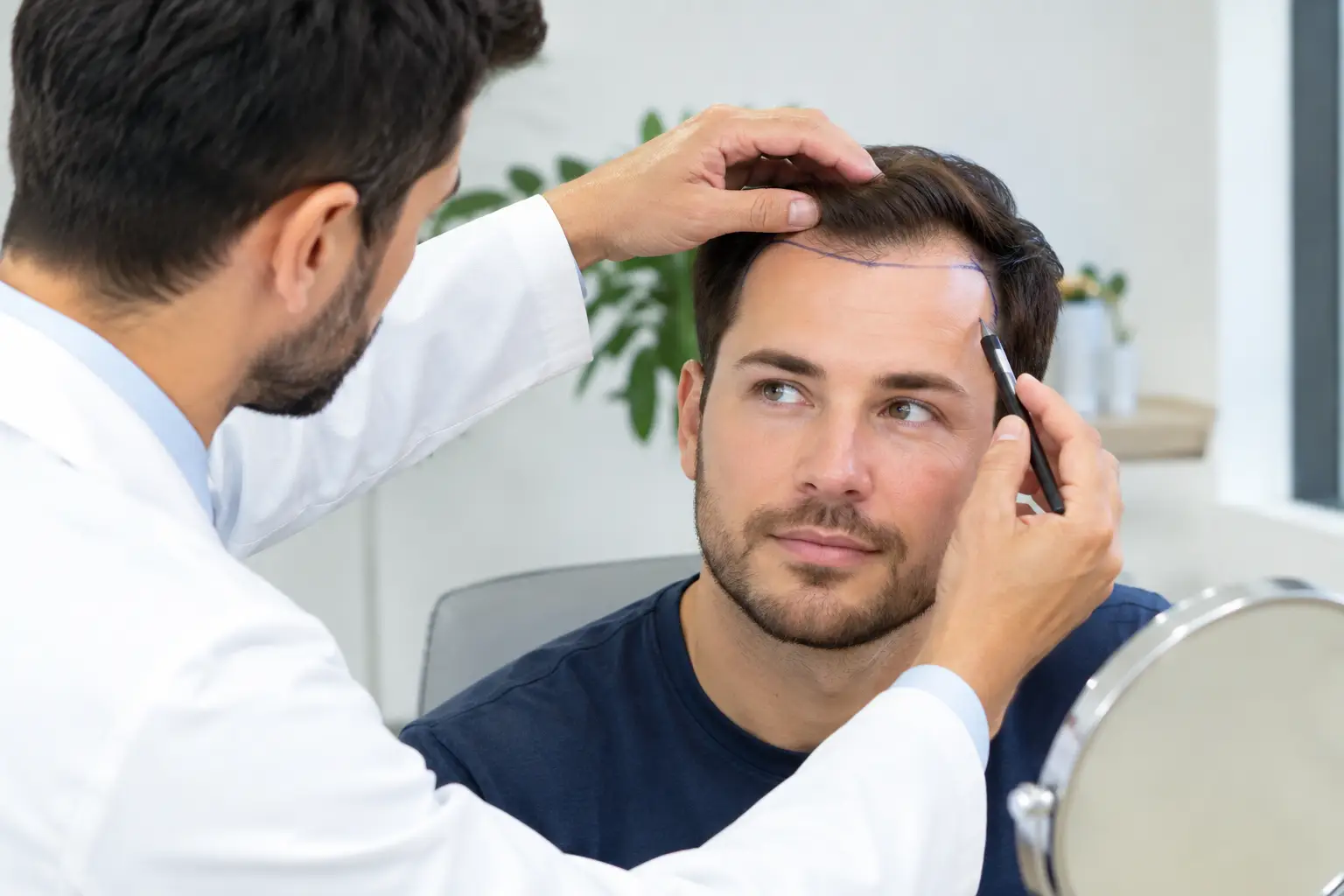
A well-designed hairline can make a hair transplant look undetectable. A poorly planned one can look too low, too straight, or out of place as natural hair changes over time. This hairline design consultation guide explains what should happen before any graft is placed, so you can approach your appointment with realistic expectations and greater confidence.
For many patients, the hairline is the most emotional part of hair restoration. It frames the face, affects how you look in photos, and can influence whether you feel your age is showing. The goal is not to recreate the hairline you had at 18. It is to create one that looks natural now and continues to suit you in the years ahead.
What a Hairline Design Consultation Should Cover
A proper consultation is more than drawing a line across the forehead. Your medical team should assess your pattern of hair loss, donor hair availability, facial proportions, hair characteristics, and likely future progression. These factors work together to determine whether a proposed design is achievable and appropriate.
Your clinician will first examine the existing frontal hairline and temples. Even when the front appears significantly recessed, small areas of native hair can help show the original direction, density, and shape. They will also assess the crown and mid-scalp, because using too many grafts at the front may leave insufficient donor supply for areas that could thin later.
At AHT Aesthetic Medical Center, planning is centered on a tailored approach rather than a one-size-fits-all template. A strong design considers the person behind the hair loss, including age, lifestyle, facial features, family history, and long-term restoration goals.
Your age and future hair loss matter
A lower hairline is not always a better hairline. This is especially relevant for younger men whose hair loss pattern may still be evolving. Creating a very low, dense frontal line can use a large number of grafts and may look unnatural if the surrounding native hair continues to recede.
For these patients, a mature, age-appropriate design is often the more conservative and attractive choice. Medication or PRP hair therapy may also be discussed when preserving existing hair is part of the treatment plan. A consultation should be candid about what surgery can improve and what may need ongoing management.
Women with hair thinning need a different assessment. Diffuse thinning, widening along the part, and reduced density behind the frontal hairline may affect transplant suitability. The right plan may involve medical evaluation, PRP treatment, a targeted transplant, or a combination based on the cause and stability of the thinning.
How Facial Proportions Shape the Hairline Design
Hairline design is an exercise in balance. Your clinician may use facial landmarks to identify a starting position, but these measurements are only a reference point. Forehead height, brow position, facial length, temple recession, and the shape of the face all influence the final design.
A hairline that is perfectly symmetrical on paper may not look natural in real life. Most natural hairlines contain slight irregularities. Subtle variation in the leading edge, carefully placed single-hair grafts, and a gradual transition from finer to denser hair help avoid the hard, plug-like appearance associated with older transplant techniques.
The temple points deserve careful attention as well. Restoring only the central frontal hairline without considering the temples can make the result feel incomplete for some patients. However, temple work requires precise angle and direction control, and it should only be included when donor supply and long-term planning support it.
Hair type changes the plan
The same hairline outline can look very different depending on the hair itself. Coarse hair may create stronger visual coverage with fewer grafts, while fine hair often requires thoughtful placement to achieve a soft, natural transition. Curly or wavy hair can provide the appearance of greater density, whereas straight hair may expose the scalp more easily under bright light.
Hair color and skin contrast also matter. Dark hair against lighter skin can make thinning more visible, while lower contrast can create a fuller visual effect. During your consultation, the team should explain how these characteristics influence density expectations rather than promising a result based only on a drawn hairline.
The Graft Plan Behind a Natural Result
Once the shape is agreed upon, the conversation should turn to graft allocation. A natural-looking frontal hairline depends on more than the total graft count. It requires the right grafts in the right locations.
Single-hair follicular units are typically selected for the very front because they create a finer, softer edge. Grafts containing two or more hairs are generally placed farther behind the hairline to build density. The direction, angle, and spacing of each graft must follow the natural growth pattern of the area.
Sapphire FUE can support this level of precision by allowing carefully controlled channel creation for graft placement. Still, no instrument replaces clinical judgment. The technique should serve the design, not dictate it. Your surgeon’s planning, the quality of donor extraction, and meticulous placement are what support a convincing result.
You should also ask how many grafts are being reserved for future needs. A responsible plan balances the desire for immediate improvement with the finite nature of the donor area. This is particularly important when there is a strong family history of advanced hair loss.
Questions to Ask During Your Consultation
The right consultation should leave you informed, not pressured. Bring photos of hairstyles or past hairlines only as a starting point. Your clinician can explain whether those references suit your facial proportions, hair type, donor capacity, and expected pattern of loss.
Ask what hairline height and shape are being recommended and why. Ask whether the design accounts for future recession, whether temple restoration is appropriate, and how grafts will be distributed across the hairline, mid-scalp, and crown if needed. You may also want to ask what portion of your donor area will be used and whether a second procedure could be possible later.
It is useful to discuss the expected timeline. Transplanted hairs commonly shed before new growth begins. Early growth may appear fine and uneven, with visible improvement typically developing over several months. Final maturation takes time, so a trustworthy team will set expectations around gradual progress rather than immediate density.
For patients traveling to Dubai or arranging treatment around work and family commitments, ask about pre-procedure preparation, aftercare, follow-up planning, and when normal activities can safely resume. Clear aftercare guidance protects the grafts during the crucial early healing period.
Signs of a Patient-Centered Consultation
You should feel that the recommendation is built around your needs, not a sales target. A professional team will examine your scalp directly, discuss medical history, explain limitations, and show you where realistic improvement is possible. They will not treat every receding hairline as the same case.
Be cautious of guarantees that promise a specific density or a permanently low hairline without discussing donor limitations and future loss. Hair restoration is highly individual. The best outcome is one that looks believable, uses donor hair wisely, and supports confidence without creating expectations that cannot be maintained.
A consultation is also the right time to address anxiety. Hair transplant surgery is a significant personal decision, and you deserve clear answers about comfort, technique, recovery, and results. Feeling heard is not separate from good medical care. It is part of it.
The most successful hairline is rarely the one that draws attention to itself. It is the one that fits your face, your hair characteristics, and the life you plan to live. When your consultation is thoughtful from the first assessment to the final graft plan, you can move forward knowing your result has been designed for more than the mirror you see today.
Ready to explore your hair restoration options?
Complete a free Hair Analysis or book a consultation with AHT Aesthetic Medical Center in Dubai.
Ready to explore your hair restoration options?
Complete a free Hair Analysis or book a consultation with AHT in Dubai.