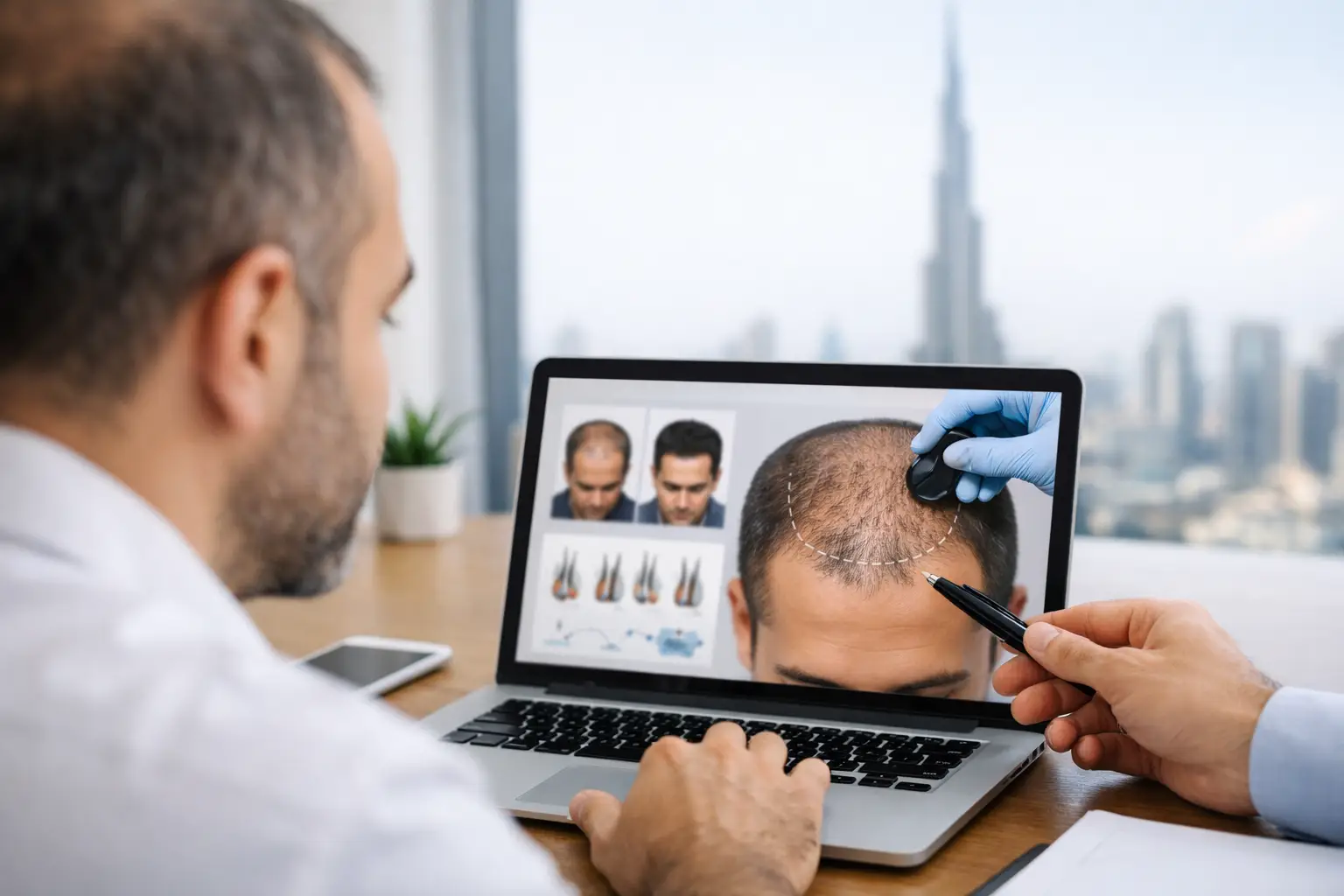
A graft estimate should give you clarity, not a misleading promise. How to Get an Accurate Hair Graft Estimate Online: A Step-by-Step Guide for Dubai Patients starts with understanding what a clinic can assess remotely and what still needs an in-person medical examination.
An online assessment can provide a useful preliminary range when your photos, hair-loss history, and expectations are clear. It cannot replace a doctor evaluating your scalp, donor area, hair characteristics, and long-term hair restoration plan. The goal is a realistic starting point that helps you make an informed decision.
What an Online Hair Graft Estimate Actually Measures
A hair graft is a naturally occurring group of one to four hairs taken from the donor area, usually at the back and sides of the scalp. The number of grafts needed is not determined by the visible bald area alone. Your hair thickness, curl pattern, contrast between hair and scalp, desired hairline, and available donor density all affect the final plan.
For example, two men with similar frontal recession may need different graft counts. A patient with fine hair or a strong contrast between dark hair and lighter scalp may require more coverage to create a natural visual density. A patient with limited donor reserves may need a more conservative design to protect options for the future.
How to Get an Accurate Hair Graft Estimate Online
The quality of the estimate depends heavily on the information you provide. Taking a few minutes to prepare your submission helps the medical team assess your case more accurately and reduces the chance of an estimate changing significantly at consultation.
- Take clear, current photos. Submit images of your front hairline, both temples, top of the scalp, crown, and donor area at the back and sides. Use bright indirect daylight or consistent indoor lighting. Keep your hair dry and avoid styling products, fibers, sprays, hats, or filters that could conceal thinning.
- Keep the camera angle consistent. Ask someone else to take the photos if possible. A handheld selfie often misses the crown and donor area, which are essential for planning. Hold the camera at a comfortable distance so the clinic can see the overall pattern as well as the density.
- Describe when your hair loss began. Include whether the thinning has been gradual or rapid, whether it is continuing, and whether close family members have similar hair-loss patterns. This helps the doctor consider the stability of your loss rather than simply filling the area that concerns you today.
- Share relevant medical and treatment history. Mention previous hair transplant procedures, scalp conditions, medication, PRP hair therapy, and any treatments you currently use. Women with diffuse thinning should also mention whether shedding is recent, whether there has been a major health change, and whether a medical evaluation has identified a cause.
- Be specific about your goal. Tell the clinic whether your priority is restoring the hairline, filling the temples, improving crown coverage, or achieving a denser overall look. If you have a preferred hairline from an earlier stage of life, share it as a reference, but remain open to a design that suits your age, facial proportions, and donor capacity.
Why Donor Area Photos Matter So Much
Many patients focus only on the balding area. However, the donor zone determines what can be safely transplanted. During a Sapphire FUE hair transplant, individual follicular units are extracted from this area and redistributed to regions of thinning.
An experienced team evaluates donor density, hair caliber, the width of the safe donor zone, and signs of miniaturization. Overharvesting can leave the donor area visibly thin and may limit future restoration options. This is why a responsible online estimate is usually expressed as a range, not an exact guarantee.
What Can Change After an In-Person Consultation
Online photos are valuable, but they have limits. Lighting can make density appear stronger or weaker, and it is difficult to fully assess scalp condition or donor quality through images alone. During a clinical consultation, the doctor can examine your scalp directly, review your medical suitability, measure the area to be treated, and create a natural hairline design.
The final graft count may be higher or lower than the initial range. That is not necessarily a concern. It often reflects a more precise examination and a treatment plan built around preserving your donor hair while delivering a balanced, natural-looking result.
Questions Worth Asking Before You Proceed
A useful online assessment should lead to a clear conversation, not pressure to book immediately. Ask whether the estimated graft range covers only the frontal area or includes the crown, how the donor area will be protected, and whether your hair loss appears stable enough for surgery. You can also ask if PRP hair therapy or medical hair restoration may support existing hair alongside a transplant plan.
For GCC patients and medical tourists, ask how the clinic manages pre-procedure screening, recovery guidance, follow-up, and remote progress reviews after you return home. A thoughtful plan considers the full patient journey, not only the procedure day.
At AHT Aesthetic Medical Center, an online graft estimate is the first step toward a personalized recommendation. Submit honest, well-lit photos and complete information, then use your consultation to confirm the safest route to fuller, natural-looking hair.
Ready to explore your hair restoration options?
Complete a free Hair Analysis or book a consultation with AHT Aesthetic Medical Center in Dubai.
Ready to explore your hair restoration options?
Complete a free Hair Analysis or book a consultation with AHT in Dubai.