If you are comparing fue vs dhi transplant, you are probably past the stage of wondering whether a hair transplant works at all. The real question is which method gives you the most natural result for your hair type, hair loss pattern, and goals. That is where good decisions matter, because the best technique is not the one with the most marketing around it. It is the one that fits your scalp, donor supply, and long-term plan.
FUE vs DHI transplant – what actually changes?
Both FUE and DHI are modern hair transplant approaches that use follicular units taken from the donor area, usually the back or sides of the scalp. In both methods, individual grafts are extracted rather than removing a strip of scalp. That means less visible scarring, faster recovery for most patients, and a more refined placement strategy than older techniques.
The main difference is not in how the grafts are harvested. It is in how they are implanted.
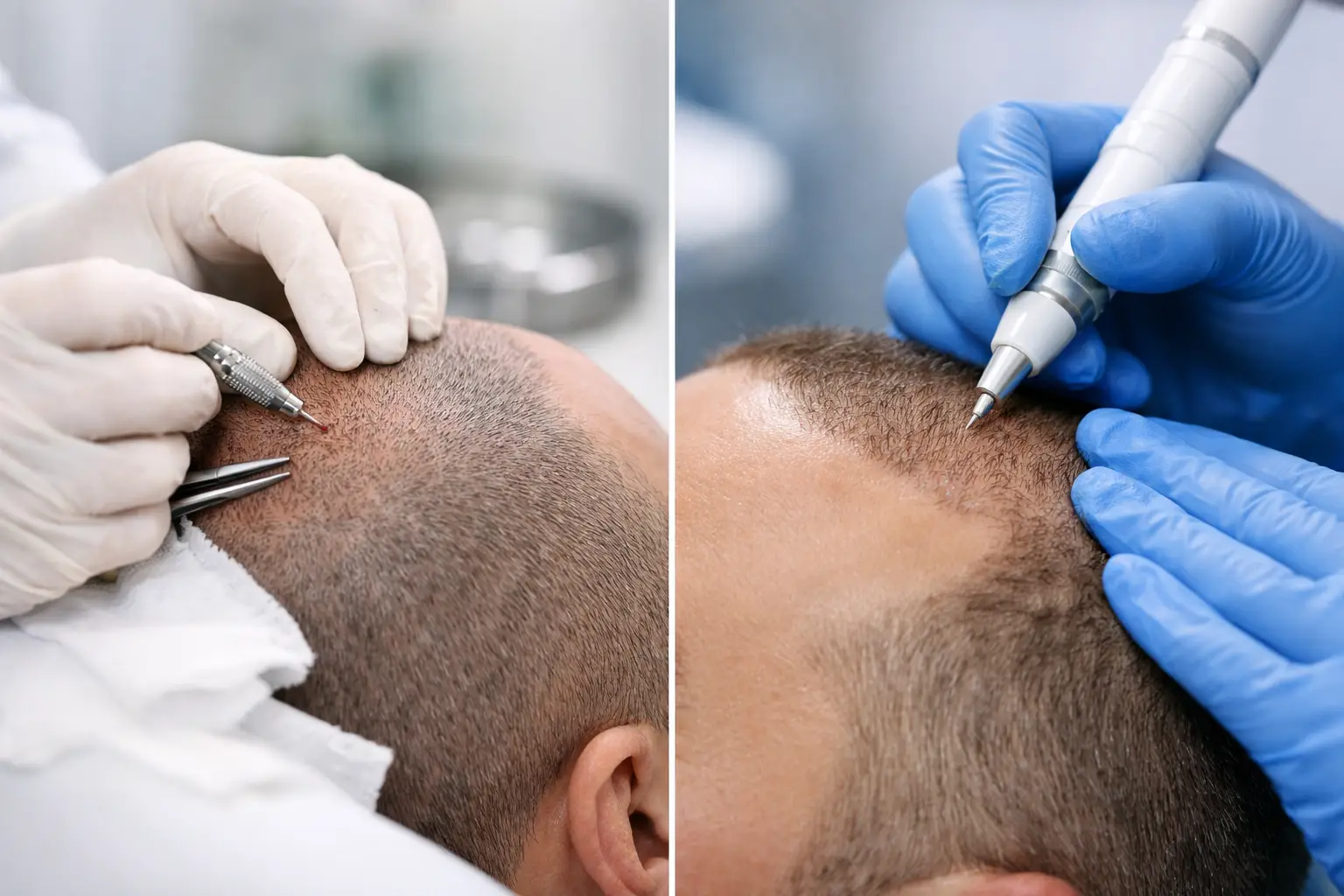
With FUE, the surgeon or medical team extracts the follicles first, then creates recipient sites in the thinning or balding area, and finally places the grafts into those sites. With DHI, the follicles are also extracted individually, but implantation is typically done using a specialized implanter pen that places the graft directly into the scalp as the site is created.
That sounds like a small technical detail, but it affects speed, control, density planning, and suitability for different cases.
How FUE works in practice
FUE stands for Follicular Unit Extraction. It is widely used because it is versatile and effective across a broad range of hair loss patterns. Once the donor area is prepared, individual follicles are removed with a micro-punch tool. After that, recipient channels are made in the target area, taking into account angle, direction, and distribution. The grafts are then implanted into those channels.
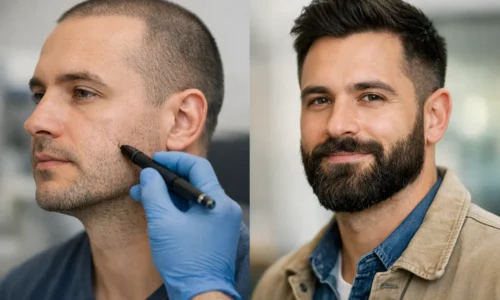
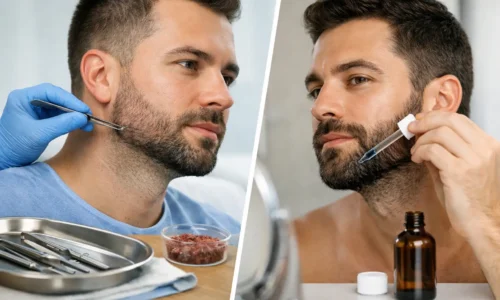
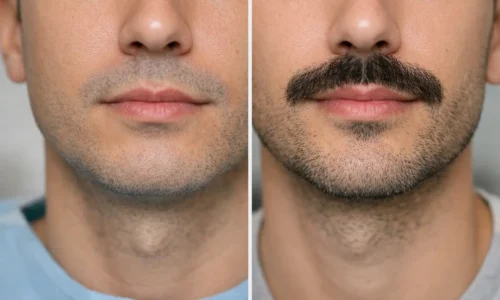
This method gives strong control over hairline design and coverage across larger areas. It is often a practical choice for patients with more advanced hair loss who need a high number of grafts. It can also work well for beard, mustache, or eyebrow restoration when performed with the right planning and finesse.
The quality of an FUE result depends less on the label and more on execution. Channel design, graft survival, donor management, and natural angling are what determine whether the final outcome looks soft and believable or obviously transplanted.
How DHI works in practice
DHI stands for Direct Hair Implantation. It is often described as a more precise variation of FUE implantation. The grafts are still harvested individually, but instead of creating all recipient sites first, the team uses an implanter pen to insert follicles directly into the thinning area.
One advantage of DHI is tighter control in specific zones, especially where precision matters. That can make it appealing for hairline refinement, smaller areas of thinning, and cases where existing native hairs need to be preserved carefully. Because the implanter pen allows simultaneous channel creation and placement, some practitioners use DHI to target denser packing in selected regions.
That said, DHI is not automatically better or denser in every patient. Results still depend on graft quality, scalp characteristics, donor availability, and the experience of the team performing the procedure.
Which one gives a more natural result?
This is the point most patients care about most, and the honest answer is that both can look extremely natural.
Natural results come from the design and placement strategy, not from the acronym alone. A natural hairline needs irregularity in the right places, single-hair grafts at the front, careful angling, and a density plan that matches your age and likely future hair loss. If those details are handled well, both FUE and DHI can produce results that are difficult to detect.
Where DHI may have an edge is in very detailed zone work, particularly along the frontal hairline or in smaller areas where precision is the priority. Where FUE may have an edge is in efficiently covering larger areas while still maintaining a natural pattern. The right choice depends on what your scalp needs, not what sounds more advanced.
FUE vs DHI transplant for density and coverage
Patients often hear that DHI means higher density. Sometimes that is true in carefully selected areas, but it should not be treated as a guarantee.
Density is influenced by several factors: the number of usable grafts, the thickness of your hair, curl pattern, scalp contrast, and how much area needs coverage. Someone with coarse, wavy hair may appear fuller with fewer grafts than someone with very fine, straight hair. A patient with limited donor supply may need a conservative plan regardless of method.
FUE is often preferred when the area of hair loss is broader and the goal is balanced coverage across the scalp. DHI can be attractive when the treatment area is smaller or when strategic packing is needed around existing hairs. For many patients, the smartest plan is not choosing the trendier option. It is choosing the method that uses donor grafts wisely.
Recovery, healing, and scarring
Both methods are considered minimally invasive and typically involve local anesthesia. Most patients can expect small scabs, mild redness, and temporary sensitivity in the donor and recipient areas. Recovery instructions matter just as much as the procedure itself, especially in the first 10 to 14 days.
Because both techniques use individual extraction, scarring is usually tiny and dot-like rather than a linear scar. For patients who like shorter hairstyles, this is often a major advantage.
Some clinics present DHI as having dramatically faster healing, but the difference is not always dramatic in real life. Healing depends on skin type, aftercare, number of grafts, and how the procedure was performed. In many cases, both FUE and DHI have very manageable downtime when done properly.
Cost differences and what you are paying for
DHI is often priced higher than standard FUE, partly because it may require different tools, workflow, and a more technique-sensitive implantation process. But cost alone should not guide the decision.
A lower price is not a good value if graft survival is poor or the hairline is unnatural. A higher price is not justified if the method is being recommended for marketing reasons rather than medical ones. What you are really paying for is clinical judgment, donor preservation, aesthetic planning, and a team that can deliver consistent results.
That is why a proper consultation matters more than comparing package names online.
Who is a better candidate for FUE?
FUE may be the better fit if you have moderate to advanced hair loss, need a larger number of grafts, or want broader scalp coverage in one session. It is also a strong option for patients who need flexibility in planning, including scalp, beard, or eyebrow restoration.
It can be especially useful when the surgeon needs to map out a wider area and distribute grafts in a way that balances immediate cosmetic improvement with future hair loss patterns. For many patients, that long-view approach is what creates the most satisfying result.
Who is a better candidate for DHI?
DHI may suit you better if your hair loss is more limited, your main concern is hairline refinement, or you still have existing hair in the target area that requires careful implantation between native follicles. It can also appeal to patients who want a highly detail-focused approach in visible zones.
Still, suitability is not based on preference alone. If donor density is weak, the scalp is very large, or the number of required grafts is high, another strategy may make more sense. A technique should serve the treatment plan, not the other way around.
The question most patients should ask instead
Instead of asking, “Which is better, FUE or DHI?” ask, “Which method makes the best use of my donor hair and gives me the most natural long-term result?”
That question changes the conversation. It moves the focus away from labels and toward outcomes. It also helps you spot a clinic that is thinking beyond the first procedure. Hair restoration is rarely just about filling an empty space. It is about planning for how your hair may continue to change over time.
At a specialist clinic such as A H T Aesthetic Medical Center, that planning process should include donor assessment, hairline design, realistic density goals, and a clear explanation of why one method fits your case better than the other.
What to expect from a real consultation
A meaningful consultation should look at your scalp, donor area, hair characteristics, medical history, and expectations. You should come away understanding how many grafts may be needed, whether medication or supportive treatments may help protect native hair, and what kind of result is realistic over the next 12 months.
If you are told that one method is best for everyone, be cautious. Hair restoration does not work that way. The strongest outcomes come from individualized planning, not one-size-fits-all recommendations.
Choosing between FUE and DHI is not about picking the newer-sounding option. It is about trusting a team that knows when precision matters most, when coverage matters more, and how to create a result that still looks like you when the hair grows in.