Hair loss rarely starts all at once. More often, it shows up in the mirror as a wider part, a thinning crown, or a hairline that keeps moving back a little more each year. When people start comparing prp vs hair transplant, they are usually asking a deeper question: what will actually give me visible, lasting improvement for my stage of hair loss?
That answer depends on what is happening at the scalp level. PRP and hair transplants both play an important role in modern hair restoration, but they do very different jobs. One is designed to stimulate and support existing follicles. The other is designed to redistribute healthy follicles into areas where hair is no longer growing well on its own.
PRP vs hair transplant: the core difference
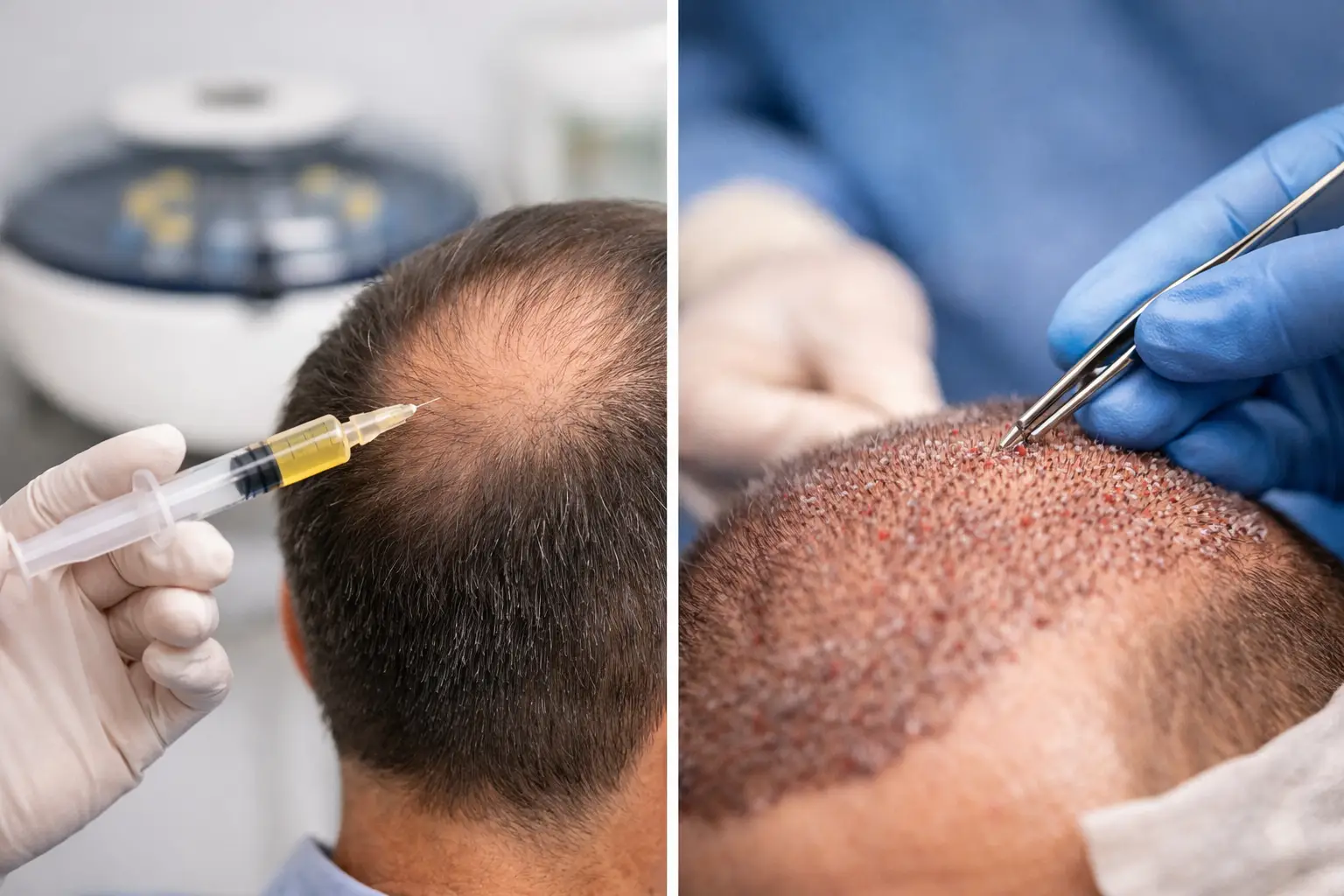
PRP stands for platelet-rich plasma. In a PRP treatment, a small sample of your blood is processed to isolate growth factor-rich plasma, which is then injected into the scalp. The goal is to improve the environment around weakened follicles and encourage stronger, healthier hair growth over time.
A hair transplant is a surgical procedure that moves grafts from a donor area, usually the back or sides of the scalp, into thinning or balding areas. Those transplanted follicles continue to grow in their new location, which makes a transplant the more definitive option when follicles in the target area are no longer producing enough viable hair.
If you want the simplest way to think about it, PRP helps struggling follicles perform better. A hair transplant replaces what has already been lost.
That distinction matters because many patients wait too long, hoping that non-surgical treatments will reverse advanced hair loss. In mild to moderate thinning, PRP can be a smart early intervention. In established bald spots or a significantly receded hairline, PRP alone usually will not create the density most people want.
When PRP makes the most sense
PRP is often best for patients who still have active follicles in the area of concern. You may notice diffuse thinning, shedding, early crown loss, or a gradual reduction in density without complete baldness. In these cases, PRP can help improve hair caliber, reduce shedding, and support the quality of existing growth.
It also appeals to people who want a minimally invasive option with little downtime. Treatment sessions are relatively quick, and most patients return to normal activity shortly after. That makes PRP attractive for busy professionals or anyone not ready for a surgical procedure.
There is a trade-off, though. PRP is not a one-time fix. It typically works best as a series of treatments followed by maintenance sessions. Results also vary from person to person because follicle health, age, hormone sensitivity, and the degree of miniaturization all influence how well the scalp responds.
PRP can also be useful as part of a broader treatment plan. For some patients, it supports transplant outcomes by improving scalp condition and strengthening native hair around transplanted grafts.
When a hair transplant is the better option
A hair transplant becomes the stronger choice when hair loss is more established and visible. If your hairline has receded significantly, your crown has a clear bald area, or your density has dropped to the point where the scalp shows prominently, a transplant is often the treatment that provides the most meaningful cosmetic change.
This is because a transplant does not rely on weak follicles suddenly becoming strong again. Instead, it relocates healthy follicles from areas genetically resistant to hair loss. For many patients, this creates the shape, density, and long-term improvement they have been trying to achieve with temporary measures.
A transplant is especially valuable when design matters. Restoring a natural-looking hairline, filling temple recession, or rebuilding density in a defined area requires careful planning, graft placement, angle control, and aesthetic judgment. The quality of the result depends not just on moving hair, but on creating a pattern that looks believable in everyday life.
The trade-off is that a transplant is still a procedure. It requires recovery, healing time, and patience while new growth develops. Final results are not immediate. Most patients see progress gradually over several months, with fuller maturation continuing after that.
PRP vs hair transplant results: what you can realistically expect
This is where many treatment decisions become clearer.
PRP results are usually subtler. Patients may notice less shedding first, then improved texture, better thickness, and more coverage in thinning areas over time. Good PRP outcomes can make hair look healthier and fuller, but they rarely create the dramatic transformation possible with transplantation.
Hair transplant results are usually more visible because they physically increase hair presence in areas that lacked coverage. A successful transplant can rebuild the front hairline, improve density where it matters most cosmetically, and create natural framing for the face.
That said, expectations still need to be grounded in reality. A transplant is limited by donor supply, scalp characteristics, and the degree of loss. The goal is not to recreate teenage density at any cost. The goal is to create natural, balanced, age-appropriate improvement that lasts.
Recovery, comfort, and downtime
PRP has the easier recovery profile. Patients may have mild tenderness or redness, but downtime is minimal. For many people, that simplicity is a major advantage.
Hair transplant recovery is still manageable, especially with modern techniques, but it is more involved. There may be temporary swelling, scabbing, and sensitivity in the donor and recipient areas. Early shedding of transplanted hairs is also expected before regrowth begins, which can surprise patients who are not prepared for the timeline.
Comfort matters too. Patients often worry that a transplant will be far more difficult than it actually is. In a well-run medical setting with experienced teams and careful planning, the procedure can be much more comfortable and controlled than expected. What matters most is knowing what to expect before, during, and after treatment.
Cost matters, but value matters more
Patients often start with cost comparisons, and that is understandable. PRP usually has a lower upfront cost than a hair transplant. But because PRP often requires multiple sessions and maintenance, the long-term investment can add up.
A hair transplant typically costs more initially, yet it may provide a more durable solution for the right candidate. If your hair loss is advanced, choosing PRP simply because it seems less expensive can become frustrating if it delays the treatment that would actually meet your goals.
The better question is not which treatment is cheaper. It is which treatment is appropriate for your level of hair loss, your expectations, and your long-term plan.
Can you combine PRP and a hair transplant?
Yes, and in many cases that is a very smart strategy.
PRP and transplantation are not competing treatments in every situation. They often work well together. A transplant can restore lost density and reshape areas that need structural improvement, while PRP can support existing hair, improve scalp health, and help maintain a fuller overall result.
This combined approach is especially helpful for patients who have both defined bald areas and ongoing thinning in surrounding zones. Treating only one part of the problem can leave the overall result looking incomplete over time.
How to choose between PRP vs hair transplant
The right choice starts with an honest diagnosis, not guesswork. You need to know whether the follicles in your thinning areas are dormant, miniaturized, or largely gone. You also need to evaluate donor strength, loss pattern, future progression, and your desired level of change.
If you are in the early stages of thinning and want to strengthen what you still have, PRP may be a strong first step. If you want to restore a receding hairline or fill areas where density has already been lost, a hair transplant is usually the more effective path.
For many patients, the decision is not about choosing the more popular option. It is about choosing the one that matches the biology of their hair loss. That is why a personalized consultation matters. At a specialist clinic such as A H T Aesthetic Medical Center, treatment planning should focus on your pattern of loss, not a one-size-fits-all recommendation.
Hair restoration works best when the plan is realistic, medically sound, and tailored to what you want to see in the mirror. If you are comparing PRP and a hair transplant, do not ask which treatment is better in general. Ask which one is better for your hair, your timeline, and the result you actually want to live with every day.